Sunday, September 15, 2019

Modern search engine optimization relies on providing valuable content that improves a site's customer experience. But the form it should take often stymies site owners.
The mention of content to ecommerce marketers often conjures images of cramming useless words into category pages, which pushes the products they're selling out of a shopper's' view. But there are many creative options for providing valuable content that drives traffic.
Content creation isn't just for big brands with deep pockets. The six sites below prove that any ecommerce site can create valuable content that appeals both to shoppers and the search engines that send them.
Blogs ecommerce blog example
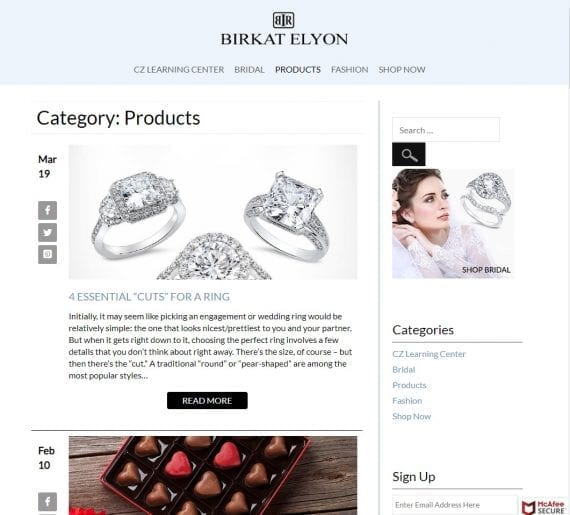
Birkat Elyon's blog post explains the four most popular cuts for engagement rings.
Blogs give searchers alternate ways to find a brand through topics that are related to the company's products. For example, the post above by cubic zirconia jeweler Birkat Elyon educates shoppers on the shapes of engagement ring stones that will stand the test of time.
As a lifestyle blog, not all of the posts are product-related. This humanizes the brand. For example, a nervous bride or groom might wonder whether she or he is ready to get married or worry that her beloved is allergic to an equally beloved pet. Ranking for posts such as these can introduce shoppers to your brand who may not have been thinking about buying jewelry — but will at some point.
I sometimes hear, "I tried blogging, and it didn't work." But a glance at the content usually tells me why. What you write about makes all the difference. Address topics that shoppers value.
Educational Resources educational ecommerce content
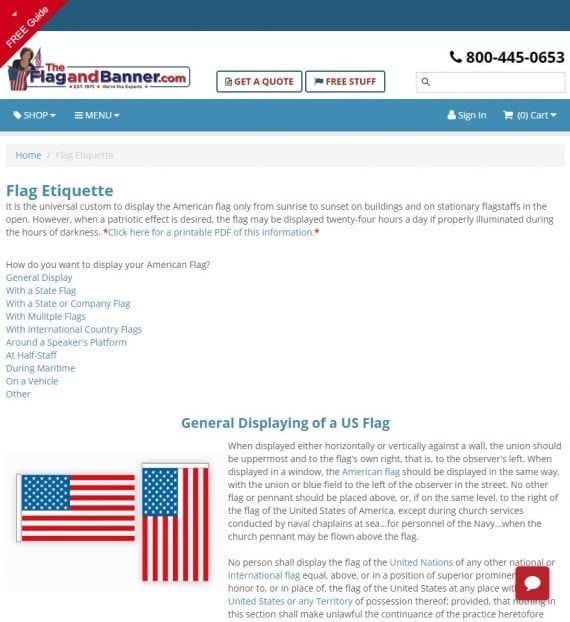
Flag and Banner's etiquette page details how to display the U.S. flag properly.
If blogs take too much effort to sustain, consider a fact-based educational guide such as the one above from flag purveyor Flag and Banner. These resources typically stay current for long periods, requiring only occasional updating.
Flag and Banner's guide ranks well in organic search because it's thorough and contains illustrations that help shoppers understand how to display each flag type.
I've never encountered an ecommerce business that lacked educational topics. With practice, you'll find topics everywhere. A question from a shopper could be a topic. Info from a manufacturer might be a topic. Keep your eyes open for learning opportunities, and you'll never be short of topics to write about.
When you have more than one article in your resource section, create a hub-and-spoke model with a category-level page (the hub) that links to all of the resource pages (the spokes) logically.
How-to Guides ecommerce content how-to example
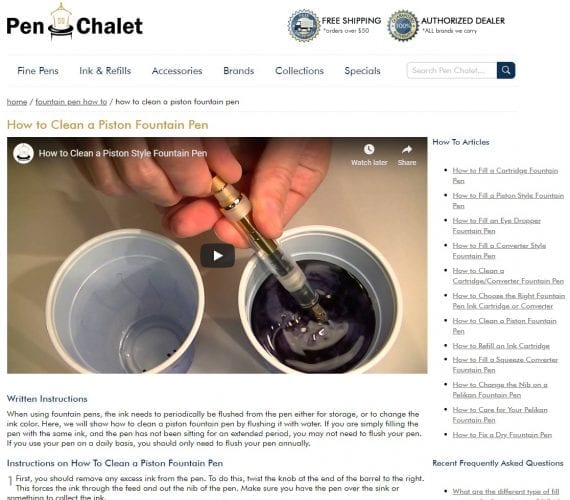
Pen Chalet' s how-to guides offer videos and step-by-step instructions with images.
How-to guides tend to be broken out into steps or sections. If a page could be titled "How to…," "10 Steps to…," or "10 Tips to…," you're probably looking at a how-to guide.
The image above shows a guide on how to clean a piston fountain pen, featuring a video and written instructions with still images in a traditional step-by-step format. With the rise of Google's answer boxes, guides are an excellent way to increase brand visibility.
Consumers increasingly prefer videos for how-to content. Regardless, both text and video content can be arranged in the hub-and-spoke model described above.
FAQs ecommerce FAQ content example
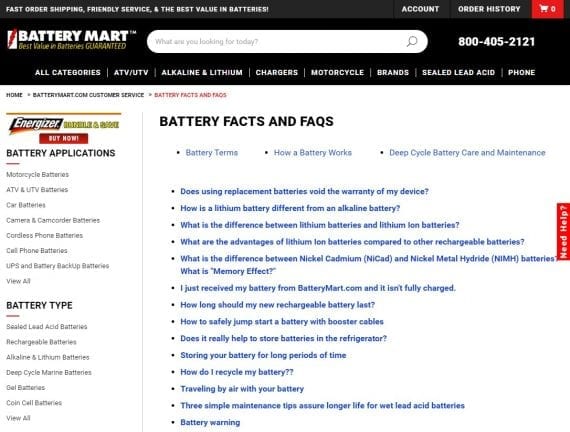
Battery Mart's FAQ section answers common questions from shoppers.
Many sites have a section for frequently asked questions — FAQs. These snippets tend to answer purely transactional questions such as shipping speed and return policy.
But the Battery Mart example above shows an FAQ relevant to its product offerings.
FAQs are the strongest for SEO when each question links to a separate page for the answer. That enables each question-and-answer pair to be optimized individually. FAQs with all of the answers on a single page have more difficulty ranking.
Support Information ecommerce support content example
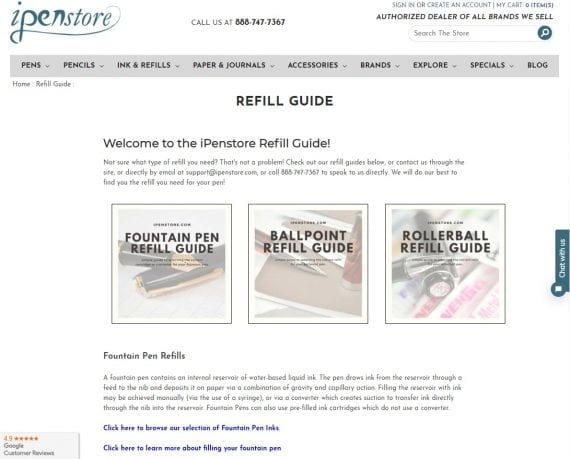
The r efill guide at iPenstore directs shoppers to the parts they need.
Search engines are also likely to rank content that answers searchers' informational intent queries. As a niche ecommerce business, iPenstore doesn't need a huge support section. Its refill guide, above, likely siphons off calls to its customer service hotline — that's the point, after all. It allows customers to find answers for product-related questions without picking up the phone.
Unfortunately, businesses don't usually value or fund their support sections. Support content can be a way to snare new shoppers as well as entice lapsed customers back — if the experience is positive.
Idea Galleries ecommerce idea gallery example
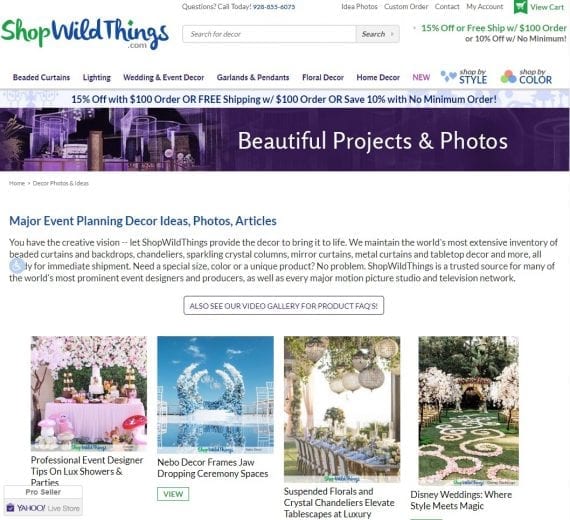
ShopWildThings wraps strong textual content around beautiful photography.
Businesses frequently waste the SEO potential of idea galleries by pasting a ton of images on a page with no supporting text. Without the expert commentary to provide context and pointers for executing the idea successfully, pretty pictures don't provide value — not for shoppers and certainly not for SEO.
In the example above, ShopWildThings, an ecommerce business offering wedding and event décor, successfully merges ideas with the blog concept. The articles feature photos from customers, often by professional photographers. The text around the images describes how the products were used to achieve the look in the photo. Because it's also natural to provide helpful links to those products, it's a compelling way to increase internal linking.

Friday, September 13, 2019

Search Engine Optimization is one of those "things" that not many people grasp. They might know what it is, and its importance, but they probably wouldn't know where to start if they had to go about practicing or implementing it. That's where SERPstash comes in handy.
According to a recent report from research firm Clutch, approximately 83 percent of large-scale digital marketing outfits say they believed they were doing a good job achieving their respective goals. But, 44 percent said SEO was their "least popular" tool.
READ: New Android phone? Do this first!
Why the disconnect? It's likely because it's not as easy as people think. Sometimes gaming a system isn't as easy as playing a game.
Don't be the guy who drops the ball in the area of SEO. Whether for yourself, or for your company, you need resources and tools, and you need to use them.
We're currently offering an all-you-need account with those exact tools: A lifetime subscription to SERPstash Premium service. Available right now for just $24 (over 90 percent off), it's your answer to SEO prayers.
SERPstash automatically analyzes your message and content, identifying top-performing keywords and auditing your pages for what you're doing — right and wrong. Moreover, it suggests keywords to fit your content as well as tips for optimization.
Features
  • Analyze & filter ranking keywords related to your industry
  • Discover who is ranking for the same keywords that you decide to target
  • Find the top 100 highest quality websites linking back to your website & who is linking to your competitors
  • Improve your site's speed w/ simple tests & insights from Google
  • Find your site's current ranking on Google & Bing
  • Identify indexed pages, top queries & backlinking pages
  • Test whether or not your pages are considered "mobile-friendly" on Google search results

  • You'll have access to nearly two dozen different tools to boost your site speed, find opportunities for improved indexing and backlinking, and more.
    SERPstash even dials in on your key competitors for deeper insight, pulling in the tricks helping them find success. You'll know where you really stand in Google search rankings, what's bringing you traffic, and the tools to land your site in Google's prized top search results.
    A year of SERPstash Premium coverage typically costs about $500, but you can take advantage of a limited time price drop and get it all for $24. Best of all, it's yours for as long as you want.
    Save even more!
    In addition to the savings above, when you buy through AndroidGuys Deals, for every $25 spent, you get $1 credit added to your account. What's more, should you refer the deal via social media or an email that results in a purchase, you'll earn $10 credit in your account.
    If this is your first time buying, then you are also eligible for a further 10% discount when you subscribe for email updates.
    How about a freebie?
    Not looking to spend any money today? That's alright, we understand. Why not visit the AndroidGuys section for freebies and take something anyhow? Go ahead, grab two!
    Nearly 15 years ago, the nofollow attribute was introduced as a means to help fight comment spam. It also quickly became one of Google’s recommended methods for flagging advertising-related or sponsored links. The web has evolved since nofollow was introduced in 2005 and it’s time for nofollow to evolve as well.
    Today, we’re announcing two new link attributes that provide webmasters with additional ways to identify to Google Search the nature of particular links. These, along with nofollow, are summarized below:

    rel="sponsored": Use the sponsored attribute to identify links on your site that were created as part of advertisements, sponsorships or other compensation agreements.

    rel="ugc": UGC stands for User Generated Content, and the ugc attribute value is recommended for links within user generated content, such as comments and forum posts.

    rel="nofollow": Use this attribute for cases where you want to link to a page but don’t want to imply any type of endorsement, including passing along ranking credit to another page.

    When nofollow was introduced, Google would not count any link marked this way as a signal to use within our search algorithms. This has now changed. All the link attributes -- sponsored, UGC and nofollow -- are treated as hints about which links to consider or exclude within Search. We’ll use these hints -- along with other signals -- as a way to better understand how to appropriately analyze and use links within our systems.
    Why not completely ignore such links, as had been the case with nofollow? Links contain valuable information that can help us improve search, such as how the words within links describe content they point at. Looking at all the links we encounter can also help us better understand unnatural linking patterns. By shifting to a hint model, we no longer lose this important information, while still allowing site owners to indicate that some links shouldn’t be given the weight of a first-party endorsement.
    We know these new attributes will generate questions, so here’s a FAQ that we hope covers most of those.

    Do I need to change my existing nofollows?
    No. If you use nofollow now as a way to block sponsored links, or to signify that you don’t vouch for a page you link to, that will continue to be supported. There’s absolutely no need to change any nofollow links that you already have.

    Can I use more than one rel value on a link?
    Yes, you can use more than one rel value on a link. For example, rel="ugc sponsored" is a perfectly valid attribute which hints that the link came from user-generated content and is sponsored. It’s also valid to use nofollow with the new attributes -- such as rel="nofollow ugc" -- if you wish to be backwards-compatible with services that don’t support the new attributes.

    If I use nofollow for ads or sponsored links, do I need to change those?
    No. You can keep using nofollow as a method for flagging such links to avoid possible link scheme penalties. You don't need to change any existing markup. If you have systems that append this to new links, they can continue to do so. However, we recommend switching over to rel=”sponsored” if or when it is convenient.

    Do I still need to flag ad or sponsored links?
    Yes. If you want to avoid a possible link scheme action, use rel=“sponsored” or rel=“nofollow” to flag these links. We prefer the use of “sponsored,” but either is fine and will be treated the same, for this purpose.

    What happens if I use the wrong attribute on a link?
    There’s no wrong attribute except in the case of sponsored links. If you flag a UGC link or a non-ad link as “sponsored,” we’ll see that hint but the impact -- if any at all -- would be at most that we might not count the link as a credit for another page. In this regard, it’s no different than the status quo of many UGC and non-ad links already marked as nofollow.
    It is an issue going the opposite way. Any link that is clearly an ad or sponsored should use “sponsored” or “nofollow,” as described above. Using “sponsored” is preferred, but “nofollow” is acceptable.

    Why should I bother using any of these new attributes?
    Using the new attributes allows us to better process links for analysis of the web. That can include your own content, if people who link to you make use of these attributes.

    Won’t changing to a “hint” approach encourage link spam in comments and UGC content?
    Many sites that allow third-parties to contribute to content already deter link spam in a variety of ways, including moderation tools that can be integrated into many blogging platforms and human review. The link attributes of “ugc” and “nofollow” will continue to be a further deterrent. In most cases, the move to a hint model won’t change the nature of how we treat such links. We’ll generally treat them as we did with nofollow before and not consider them for ranking purposes. We will still continue to carefully assess how to use links within Search, just as we always have and as we’ve had to do for situations where no attributions were provided.

    When do these attributes and changes go into effect?
    All the link attributes, sponsored, ugc and nofollow, now work today as hints for us to incorporate for ranking purposes. For crawling and indexing purposes, nofollow will become a hint as of March 1, 2020. Those depending on nofollow solely to block a page from being indexed (which was never recommended) should use one of the much more robust mechanisms listed on our Learn how to block URLs from Google help page.

    Posted by Danny Sullivan and Gary
    Crawl budget is a vital SEO concept that often gets overlooked.
    There are so many tasks and issues an SEO expert has to keep in mind that it's often put on the back burner.
    In short, crawl budget can, and should, be optimized.
    In this article, you will learn:


  • How to improve your crawl budget along the way.
  • Go over the changes to crawl budget as a concept in the last couple of years.
  • What Is Crawl Budget
    So for those of us who've had so much to think/worry/sweat about that we forgot what crawl budget even means, here's a quick recap.
    Crawl budget is simply the frequency with which search engine's crawlers (i.e., spiders and bots) go over the pages of your domain.
    That frequency is conceptualized as a tentative balance between Googlebot's attempts to not overcrowd your server and Google's overall desire to crawl your domain.
    Crawl budget optimization is just a series of steps that you can take specifically to up the rate at which search engines' bots visit your pages.
    The more often they visit, the quicker it gets into the index that the pages have been updated.
    Consequently, your optimization efforts will take less time to take hold and start affecting your rankings.
    With that wording, it certainly sounds like the most important thing we all should be doing every second, right?
    Well, not entirely.
    Why Is Crawl Budget Optimization Neglected?
    To answer that question, you only need to take a look at this official blog post by Google.
    As Google explains plainly, crawling by itself is not a ranking factor.
    So that alone is enough to stop certain SEO professionals from even thinking about crawl budget.
    To many of us, "not a ranking factor" is equated to "not my problem."
    I disagree with that wholeheartedly.
    But even forgetting that, there are Google's Gary Illyes' comments. He has stated outright that, sure, for a huge website of millions and millions of pages, crawl budget management makes sense.
    But if you're a modestly-sized domain, then you don't have to actually concern yourself too much with crawl budget. (And in fact added that if you really have millions and millions of pages, you should consider cutting some content, which would be beneficial for your domain in general.)
    But, as we all know, SEO is not at all a game of changing one big factor and getting the results.
    SEO is very much a process of making small, incremental changes, taking care of dozens of metrics.
    Our job, in a big way, is about making sure that thousands of tiny little things are as optimized as possible.
    In addition, although it's not a big crawling factor by itself, as Google's John Mueller points out, it's good for conversions and for the overall website health.
    With all that said, I feel it's important to make sure that nothing on your website is actively hurting your crawl budget.
    How to Optimize Your Crawl Budget Today
    There are still things that are super heavy-duty and others' importance has changed dramatically to a point of not being relevant at all.
    You still need to pay attention to what I call the "usual suspects" of website health.
    1. Allow Crawling of Your Important Pages in Robots.Txt
    This is a no-brainer, and a natural first and most important step.
    Managing robots.txt can be done by hand, or using a website auditor tool.
    I prefer to use a tool whenever possible. This is one of the instances where a tool is simply more convenient and effective.
    Simply add your robots.txt to the tool of your choice will allow you to allow/block crawling of any page of your domain in seconds. Then you'll simply upload an edited document and voila!
    Obviously, anybody can pretty much do it by hand. But from my personal experience I know that with a really large website, where frequent calibrations might be needed, it's just so much easier to let a tool help you out.
    2. Watch Out for Redirect Chains
    This is a common-sense approach to website health.
    Ideally, you would be able to avoid having even a single redirect chain on your entire domain.
    Honestly, it's an impossible task for a really large website – 301 and 302 redirects are bound to appear.
    But a bunch of those, chained together, definitely hurt your crawl limit, to a point where search engine's crawler might simply stop crawling without getting to the page you need indexed.
    One or two redirects here and there might not damage you much, but it's something that everybody needs to take good care of nevertheless.
    3. Use HTML Whenever Possible
    Now, if we're talking Google, then it has to be said that its crawler got quite a bit better at crawling JavaScript in particular, but also improved in crawling and indexing Flash and XML.
    On the other hand, other search engines aren't quite there yet.
    Because of that, my personal standpoint is, whenever possible, you should stick to HTML.
    That way, you're not hurting your chances with any crawler for sure.
    4. Don't Let HTTP Errors Eat Your Crawl Budget
    Technically, 404 and 410 pages eat into your crawl budget.
    And if that wasn't bad enough, they also hurt your user experience!
    This is exactly why fixing all 4xx and 5xx status codes is really a win-win situation.
    In this case, again, I'm in favor of using a tool for website audit.
    SE Ranking and Screaming Frog are a couple of great tools SEO professionals use to do a website audit.
    5. Take Care of Your URL Parameters
    Always keep in mind that separate URLs are counted by crawlers as separate pages, wasting invaluable crawl budget.
    Again, letting Google know about these URL parameters will be a win-win situation, save your crawl budget, as well as avoid raising concerns about duplicate content.
    So be sure to add them to your Google Search Console account.
    6. Update Your Sitemap
    Once again, it's a real win-win to take care of your XML sitemap.
    The bots will have a much better and easier time understanding where the internal links lead.
    Use only the URLs that are canonical for your sitemap.
    Also, make sure that it corresponds to the newest uploaded version of robots.txt.
    7. Hreflang Tags Are Vital
    In order to analyze your localized pages, crawlers employ hreflang tags. And you should be telling Google about localized versions of your pages as clearly as possible.
    First off, use the <link rel="alternate" hreflang="lang_code" href="url_of_page" /> in your page's header. Where "lang_code" is a code for a supported language.
    And you should use the <loc> element for any given URL. That way, you can point to the localized versions of a page.
    Summary
    So if you were wondering whether crawl budget optimization is still important for your website, the answer is clearly yes.
    Crawl budget is, was, and probably will be an important thing to keep in mind for every SEO professional.
    Hopefully these tips will help you optimize your crawl budget and improve your SEO performance.
    Good luck!
    More Resources:
    Image Credits
    Featured Image: Created by author, August 2019Screenshots taken by author, August 2019
    Gone are the days when a single tweak in the content or the title tag was able to get your site to the top of the search results.
    Google algorithm is now much harder to crack than before. Besides, 75 percent of online users do not scroll past the first page of the search engine results.
    As you can imagine, this makes the SEO space highly competitive right now and companies can no longer rely on basic techniques.
    However, you can always make sure that the odds are in your favor by using data science.
    What is data science?
    A combination of various tools, algorithms, and machine learning principles designed to unveil hidden patterns using the raw data is referred to as data science.
    Data science is creating its impression across every domain. As cited by Maryville University, around 1.7 megabytes of data will be generated every second for everyone on the planet by the end of 2020.
    Why do you need it?
    Data science provides valuable insights about a website's performance and these insights can help you improve your SEO campaigns.
    Data science is used to make predictions about upcoming trends and customer behavior using analytics and machine learning. For example, Netflix uses insight from data science to produce its original series that drives user interest.
    Apart from identifying opportunities, data science also handles high voluminous data and helps in making better decisions. Businesses can easily gauge the effectiveness of a marketing campaign with the help of data science.
    How does data science help SEO?
    Data science helps you make concrete decisions by letting you:


  • Visualize which combinations have the potential to make the biggest impact
  • Create marketing campaigns aligned with the needs of their audience
  • Understand buyer's preferences and identify pain points
  • Identify referral sources of converting traffic
  • Verify loading time, indexing, bounce rate, response errors, and redirects
  • Verify the most and least crawled URLs
  • Identify pages that crawlers aren't supposed to index
  • Identify sources of unusual traffic
  • How do you apply data science to your SEO data?
    Follow the below ways to apply data science to your SEO campaigns:
    1. Select your data sources
    Understand that the quality of your data sources directly impacts your data insights. You need the right tools to track important metrics more precisely. The top four tools that can help you gather the right data and make better decisions are Google Analytics, SEMrush, and Ahrefs.
    2. Think "ecosystem" instead of "data" and "tools" 
    Do not rely on one solution if your SEO is complex and integrates with various other digital marketing areas like content marketing, CX management, CRO, and sales. The "data science" approach to SEO is about integrating methods, tools, and practices in a way that draws deep and accurate insights from the cumulative data mix. Consider the SEMRush console we discussed above. The traffic stats it presents work on the assumption that all traffic is genuine. What if there are bad bots at play here? It makes a lot of sense to bring in a traffic quality checking tool into the mix, something like what Finteza does.
    Example of using Finteza to improve SEO using data science
    Source: Finteza
    It offers you advanced bot detection tech, along with a whole suite of conversion funnel optimization modules, to help you not only make more sense of your data but also to put the insight into action, to drive business KPI scores.
    3. Align SEO with marketing initiatives 
    Backing your SEO with other marketing initiatives makes it stronger. Collaborate with sales, developers, UX designers, and customer support teams to optimize for all search ranking factors.
    Use data science to determine a universal set of SEO best practices each team can follow to achieve your goal. Try tracking the evolving relationships between independent and dependent variables to get a better idea of what actions are important to your business. To fully understand how your SEO affects other channels, capture and analyze data from:


  • Top conversion paths
  • Conversions and assisted conversions

  • Gain a clear understanding of your customers' journeys to establish a stronger alignment between various marketing activities and attribute the outcomes to separate campaigns easily.
    4. Visualize with data science
    Find it hard to digest numbers piled onto a spreadsheet? Taking a hierarchical approach to your data can cause you to miss out on important hidden between the lines. On the other hand, draw different benefits from data visualizations like:


  • Compare and contrast
  • Process large data volumes at scale
  • Accelerate knowledge discovery
  • Reveal hidden questions
  • Spot common patterns and trends

  • Test it out yourself. Leverage data science during an SEO technical audit and receive insights about your site's health and performance. Use that data to know more about your page authority, rankings, number of outbound/inbound links per page, and other factors. However, you won't find a proper answer about why some pages perform better in the search results, while the others lag behind. Visualizing the site's internal link structure and figuring out the domain authority of individual pages on a scale of one to ten (like Google) allows you to see the areas for improvement and adopt proactive measures.
    On-page SEO optimization is just a single example of how SEO experts combine visualizations with data science to provide better results to clients. Make your SEO data more actionable with visualizations.
    5. Take help of A/B testing
    LinkedIn carried out an experiment using the XNLT platform. The experiment was focused on the redesign of the "Premium Subscription" payment flow. The LinkedIn UX team reduced the number of payment checkout pages and added a FAQ. The results were impressive with an increase in the number of annual bookings which was worth millions of dollars, a 30% reduction in refund orders and a 10% increase in free trial subscriptions.
    Concluding remarks
    Data science focuses on eliminating guesswork from SEO. Rather than presuming what works and how a specific action affects your goals, use data science to know what's bringing you the desired results and how you're able to quantify your success. Brands like Airbnb are already doing it and so can you.
    Joydeep Bhattacharya is a digital marketing evangelist and author of the SEO Sandwitch blog.
    Related reading
    In the data set that I used businesses were found via non-branded searches 70% of the time vs. 30% of the time via a branded search.
    A marketing feedback loop is when a business uses responses they get from a campaign or product on the social web. Ways to identify and use it to improve SEO.
    In a world of highly customized SERPs and a host of ranking signals for local search that Google uses, relevant ranking data is as challenging.
    Keyword research can be stressful. This guide explains the process of researching keywords to help you begin and improve your content marketing strategy.
    Getty
    Over the summer I had many discussions with people about how new technology has changed their lives—both for the positive and the negative. Many shared how smartphones allow them to multi-task when standing in lines as they respond to email or as they are on hold waiting to speak to customer service. Others spoke of how they have access to information that is up to date on matters of health, taxes and investments without having to go to the local library as was often the case pre-internet. Overall, most were impacted by the way that e-mail allows them to communicate with everyone without having to queue at the post office much less without the need to print out letters on printers. However, many people mentioned that their culture had changed negatively in reaction to new technology: "Everyone is always looking at their mobiles," said one and another added, "It is almost easier to write someone an SMS while standing next to them." All, however, felt that technology was not at all linked to culture and that it was something external to culture.
    So, I would ask everyone why they thought culture was somehow separate from technology since it seems to me that we can no longer make this bifurcation as technology not only informs culture, but culture is also reactive to new technology. Both culture and new tech change in response to each other. Moreover, culture has always been as much a marketing creation over the past century as it has been an autochthonous element of historical precedent. Can we make the claim that Coca-Cola is not cultural simply because it was originally a marketing creation? How can we claim that chatbots or social media are not cultural simply because they are originally products of technology?
    Indeed, scholars like Ashis Nandy of India have been asking these sorts of questions for decades as he has queried the link between science and state reason. Similarly, French philosopher Jean-Luc Nancy examines the link between cultural constructions of "catastrophe" and technology. We already know that culture is a product of various forces, so why not can we not accept that perhaps our culture might very well be the end result of engineering in the form of marketing? Certainly, after the Cambridge Analytica scandal, we should not only be firmly aware of this fact but we ought to be more conscious as to how we interact with marketing, not necessarily embracing it full-on nor outright rejecting these messages as entirely suspicious. Perhaps internet marketing is yet another chapter in our cultural trajectory towards being exposed to new ideas and technologies through more direct, if not aggressive, approaches?
    Victor Smushkevich, CEO of Los Angeles based internet marketing agency, Smart Street Media, tells me the strategy of marketing his company employs is not about selling a product specifically: "The goal of our brand is not to sell a product or a company, but instead we aim to sell cultural change. In so doing we force the individual user to contemplate their relation to new technology—from how often and when they use technology to how this tech can positively affect their lives." Smushkevich goes on to tell me that by focussing on web content his company is necessarily adding to the larger cultural discussion which themselves are a part of culture. "You can't divorce online content from society," he tells me, "The internet is here to stay and it serves as one vast expanse of information—spanning the range of online, immediate information and news to online graffiti. This is what culture is."
    Just as we have historically framed cultural value within advertising through accolades such as the Clio Awards, we have similarly come to embrace both the Webby Awards and Business Globe Awards for innovations with their respective fields linking business and advertising innovation to our cultural fabric. Why would advertising Man Men-style be any more relevant to culture than the tackiest of pop-up adverts or mark eting layouts? Certainly, we are living the moment where the medium is not only the message, but the medium is most definitely a primary cog in our culture.
    As marketing is often being deputized to media influencers today bringing the cultural relevance of materials and services towards a digital anonymity of branding, we are living in a material landscape where the individual spokesperson—neither a retired football star nor a supermodel—is flung into social media "stardom" all for representing the alleged "real face" of a brand. Where authenticity used to mean the elusive symbol of power was something that everyone would aspire to be (and hence purchase), today the symbols of desire and power are more often than not the unknown individual who is able to spread the word via blog, photos and social media posts online. These recent trends in new tech and social media reveal a cultural undertow whereby it no longer desirable to represent what people want to become but rather new technology is selling us the image of who we might already be.

    Wednesday, September 11, 2019

    Google is a massive company that touches the lives of almost everyone in the US, and that has led to increasing regulatory pressure. Amid rumors of a federal probe, 50 attorneys general have joined forces to launch an antitrust probe of the company. According to Texas AG Ken Paxton, the leader of the investigation, the inquiry will focus on Google's advertising business, but it could expand depending on what they find.

    The probe includes the attorneys general of 48 states, Washington DC, and Puerto Rico. Just California (Google's home state) and Alabama are uninvolved. An antitrust investigation like this could run parallel with a federal case, causing considerable headaches for Google. Ultimately, the company could be slapped with a hefty fine, forced to alter its practices to improve competition, made to spin off some businesses, or all of the above.

    Google is not alone among big tech firms when it comes to antitrust scrutiny. The Department of Justice is currently probing Apple, Amazon, and Google. Multiple attorneys general are also investigating Facebook for... well, everything Facebook does. The FTC has a separate probe of the social network. We've reached out to Google for comment and will update if we hear back.

    pointed to a post made on Friday as its response, which apparently anticipated the announcement today. In the post, Google points out that it has created thousands of jobs and is one of the top spenders on research and development in the US. Google says answering the questions of government regulators is nothing new, and it will have similar answers for the attorneys general. It's basically a few hundred words of highly polished PR-speak.