Showing posts with label Google Algorithm. Show all posts

Friday, September 13, 2019

Nearly 15 years ago, the nofollow attribute was introduced as a means to help fight comment spam. It also quickly became one of Google’s recommended methods for flagging advertising-related or sponsored links. The web has evolved since nofollow was introduced in 2005 and it’s time for nofollow to evolve as well.
Today, we’re announcing two new link attributes that provide webmasters with additional ways to identify to Google Search the nature of particular links. These, along with nofollow, are summarized below:

rel="sponsored": Use the sponsored attribute to identify links on your site that were created as part of advertisements, sponsorships or other compensation agreements.

rel="ugc": UGC stands for User Generated Content, and the ugc attribute value is recommended for links within user generated content, such as comments and forum posts.

rel="nofollow": Use this attribute for cases where you want to link to a page but don’t want to imply any type of endorsement, including passing along ranking credit to another page.

When nofollow was introduced, Google would not count any link marked this way as a signal to use within our search algorithms. This has now changed. All the link attributes -- sponsored, UGC and nofollow -- are treated as hints about which links to consider or exclude within Search. We’ll use these hints -- along with other signals -- as a way to better understand how to appropriately analyze and use links within our systems.
Why not completely ignore such links, as had been the case with nofollow? Links contain valuable information that can help us improve search, such as how the words within links describe content they point at. Looking at all the links we encounter can also help us better understand unnatural linking patterns. By shifting to a hint model, we no longer lose this important information, while still allowing site owners to indicate that some links shouldn’t be given the weight of a first-party endorsement.
We know these new attributes will generate questions, so here’s a FAQ that we hope covers most of those.

Do I need to change my existing nofollows?
No. If you use nofollow now as a way to block sponsored links, or to signify that you don’t vouch for a page you link to, that will continue to be supported. There’s absolutely no need to change any nofollow links that you already have.

Can I use more than one rel value on a link?
Yes, you can use more than one rel value on a link. For example, rel="ugc sponsored" is a perfectly valid attribute which hints that the link came from user-generated content and is sponsored. It’s also valid to use nofollow with the new attributes -- such as rel="nofollow ugc" -- if you wish to be backwards-compatible with services that don’t support the new attributes.

If I use nofollow for ads or sponsored links, do I need to change those?
No. You can keep using nofollow as a method for flagging such links to avoid possible link scheme penalties. You don't need to change any existing markup. If you have systems that append this to new links, they can continue to do so. However, we recommend switching over to rel=”sponsored” if or when it is convenient.

Do I still need to flag ad or sponsored links?
Yes. If you want to avoid a possible link scheme action, use rel=“sponsored” or rel=“nofollow” to flag these links. We prefer the use of “sponsored,” but either is fine and will be treated the same, for this purpose.

What happens if I use the wrong attribute on a link?
There’s no wrong attribute except in the case of sponsored links. If you flag a UGC link or a non-ad link as “sponsored,” we’ll see that hint but the impact -- if any at all -- would be at most that we might not count the link as a credit for another page. In this regard, it’s no different than the status quo of many UGC and non-ad links already marked as nofollow.
It is an issue going the opposite way. Any link that is clearly an ad or sponsored should use “sponsored” or “nofollow,” as described above. Using “sponsored” is preferred, but “nofollow” is acceptable.

Why should I bother using any of these new attributes?
Using the new attributes allows us to better process links for analysis of the web. That can include your own content, if people who link to you make use of these attributes.

Won’t changing to a “hint” approach encourage link spam in comments and UGC content?
Many sites that allow third-parties to contribute to content already deter link spam in a variety of ways, including moderation tools that can be integrated into many blogging platforms and human review. The link attributes of “ugc” and “nofollow” will continue to be a further deterrent. In most cases, the move to a hint model won’t change the nature of how we treat such links. We’ll generally treat them as we did with nofollow before and not consider them for ranking purposes. We will still continue to carefully assess how to use links within Search, just as we always have and as we’ve had to do for situations where no attributions were provided.

When do these attributes and changes go into effect?
All the link attributes, sponsored, ugc and nofollow, now work today as hints for us to incorporate for ranking purposes. For crawling and indexing purposes, nofollow will become a hint as of March 1, 2020. Those depending on nofollow solely to block a page from being indexed (which was never recommended) should use one of the much more robust mechanisms listed on our Learn how to block URLs from Google help page.

Posted by Danny Sullivan and Gary
Wednesday, September 11, 2019

Sign up for our daily recaps of the ever-changing search marketing landscape.
Note: By submitting this form, you agree to Third Door Media's terms. We respect your privacy.
Google updated its Search Quality Rater Guidelines on September 5; the update was first brought to the attention of the SEO community via a tweet from SEM consultant Marie Haynes. This latest version places more emphasis on vetting news sources as well as YMYL content and its creators and expands the basis for which a rater might apply the lowest ratings to content that may potentially spread hate. The previous update occurred on May 16.
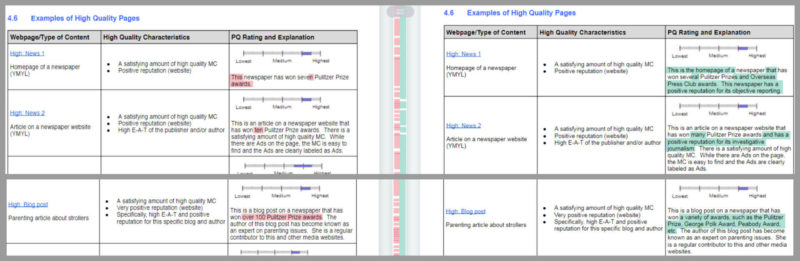
Below is an analysis of the changes. The May 16 version of the guidelines appears on the left-hand side of the screenshots, with the corresponding section of the latest version on the right-hand side.
2.3: Your Money or Your Life (YMYL) Pages
Addition of the word "topics," broadening the content that this section may pertain to beyond web pages.
The previous "News articles or public/official Information pages Important for having an Informed citizenry" and the "Legal Information pages" sections have been reorganized and replaced with "News and current events" and "Civics, government, and law," which now appear at the top of the list.
"News and current events" features examples of news that may not necessarily be considered YMYL. The term "voting" is explicitly mentioned in the new "Civics, government, and law" section.
"Shopping" and "Finance" are now two separate categories. "Shopping" YMYL content now includes "information about or services related to research or purchase of goods/services," such as reviews.
"Groups of people" is also a new section; the description could be interpreted as pertaining to hate groups, solidarity groups or anything in between.
The "Other" section now also provides more examples of content that could be considered YMYL.
2.5.2 Finding Who is Responsible for the Website and Who Created the Content on the Page
This subsection of 2.5 (Understanding the Website) adds "Websites want users to be able to distinguish between content created by themselves versus content that was added by other users." For users, being able discern between in-house and third-party content may affect the publisher's reputation. For example, lyrics website Genius accused Google of stealing its content; only then did Google disclose that it licenses lyrics from third parties.
The final sentence of the subsection increases the responsibility borne by websites that syndicate content from just having to possess the appropriate licenses to now also potentially being held accountable for the quality of that licensed content.
2.6.1 Research on the Reputation of the Website or Creator of the Main Content
This subsection of 2.6 (Reputation of the Website or Creator of the Main Content) puts more emphasis on print media by replacing "newspaper website" with "newspaper (with an associated website)." It also allows search quality raters to take a track record of high-quality, original reporting into account — not just awards won by a publication.
4.6 Examples of High Quality Pages

The Page Quality (PQ) Rating and Explanation sections of three examples have been expanded. In line with the additions from 2.6.1 above, the news explanations now include having a positive reputation for objective reporting and investigative journalism.
Overall, the guidelines seem to be moving away from Pulitzers as the be all, end all of awards and are instructing raters to acknowledge other accolades as well.
5.0 Highest Quality Pages
Section 5.1 (Very High Quality Main Content) now expands YMYL topics outside the bounds of news articles and information pages. There are now criteria for news, artistic and informational content.
Section 5.2 (Very Positive Reputation) removes the reference to E-A-T and reminds raters to carefully check the reputation of YMYL content creators.
Section 5.3 (Very High Level of E-A-T) raises the overall bar for YMYL content, but acknowledges that standards for E-A-T will vary. It also adds video as a content source.
5.4 (Examples of Highest Quality Pages) now features two examples of high-quality news, with explanations that emphasize awards, high-quality main content, uniqueness, originality, depth and investigative journalism.
The "Highest: Entertainment" example is not present on the latest iteration of the guidelines.
The explanations for three high-quality video examples have been expanded to include uniqueness and originality.
6.7 Examples of Low Quality Pages
Four examples from this section now carry the YMYL label.
7.3 Pages That Potentially Spread Hate
"Criteria" has been removed and replaced with broader bases for applying the lowest page rating. There is also a stronger emphasis on groups.
11.0 Page Quality Rating FAQs
Google has made it more explicit to its raters that pages existing for the sake of artistic expression, humor, entertainment and the like are "all valid and valued page purposes," and thus may not necessarily deserve a low quality rating because they do not serve more practical purposes.
12.9 Rating on Your Phone Issues
Google is no longer telling raters to assume, by default, that queries with device-specific results were issued on an Android device.
13.2.1 Examples of Fully Meets (FullyM) Result Blocks
The note once-attached to this explanation has been removed. This is in line with abandoning the assumption that device-specific results are coming from Android devices (mentioned above in 12.9).
13.5.1 Examples of Slightly Meets (SM) Result Blocks
The "ellen degeneres" example has been removed.
13.6 Fails to Meet (FailsM)
The "zoo atlanta" example has been removed.
14.6.1 Using the Upsetting-Offensive Flag

As with section 7.3, the word "criteria" has been removed, allowing for a wider bases with which to justify applying the Upsetting-Offensive flag. There is also additional emphasis on groups of people.
About The Author George Nguyen is an Associate Editor at Third Door Media. His background is in content marketing, journalism, and storytelling.
Sign up for our daily recaps of the ever-changing search marketing landscape.
Note: By submitting this form, you agree to Third Door Media's terms. We respect your privacy.

Thursday, February 9, 2017

If you Google “Was the Holocaust real?” right now, seven out of the top 10 results will be Holocaust denial sites. If you Google “Was Hitler bad?,” one of the top results is an article titled, “10 Reasons Why Hitler Was One Of The Good Guys.”
In December, responding to weeks of criticism, Google said that it tweaked it algorithm to push down Holocaust denial and anti-Semitic sites. But now, just a month later, their fix clearly hasn’t worked.
In addition to hateful search results, Google has had a similar problem with its “autocompletes” — when Google anticipates the rest of a query from its first word or two. Google autocompletes have often embodied racist and sexist stereotypes. Google image search has also generated biased results, absurdly tagging some photos of black people as “gorillas.”
The result of these horrific search results can be deadly. Google search results reportedly helped shape the racism of Dylann Roof, who murdered nine people in a historically black South Carolina church in 2015. Roof said that when he Googled “black on white crime, the first website I came to was the Council of Conservative Citizens,” which is a white supremacist organization. “I have never been the same since that day,” he said. And of course, in December, a Facebook-fueled fake news story about Hillary Clinton prompted a man to shoot up a pizza parlor in Washington D.C. The fake story reportedly originated in a white supremacist’s tweet.
These terrifying acts of violence and hate are likely to continue if action isn’t taken. Without a transparent curation process, the public has a hard time judging the legitimacy of online sources. In response, a growing movement of academics, journalists and technologists is calling for more algorithmic accountability from Silicon Valley giants. As algorithms take on more importance in all walks of life, they are increasingly a concern of lawmakers. Here are some steps Silicon Valley companies and legislators should take to move toward more transparency and accountability:

1. Obscure content that’s damaging and not of public interest.

When it comes to search results about an individual person’s name, many countries have aggressively forced Google to be more careful in how it provides information. Thanks to the Court of Justice of the European Union, Europeans can now request the removal of certain search results revealing information that is “inadequate, irrelevant, no longer relevant or excessive,” unless there is a greater public interest in being able to find the information via a search on the name of the data subject.
Such removals are a middle ground between information anarchy and censorship. They neither disappear information from the internet (it can be found at the original source) nor allow it to dominate the impression of the aggrieved individual. They are a kind of obscurity that lets ordinary individuals avoid having a single incident indefinitely dominate search results on his or her name. For example, a woman in Spain whose husband was murdered 20 years ago successfully forced Google Spain to take news of the murder off search results on her name.
Such removals are a middle ground between information anarchy and censorship.

2. Label, monitor and explain hate-driven search results.

In 2004, anti-Semites boosted a Holocaust-denial site called “Jewwatch” into the top 10 results for the query “Jew.” Ironically, some of those horrified by the site may have helped by linking to it in order to criticize it. The more a site is linked to, the more prominence Google’s algorithm gives it in search results.
Google responded to complaints by adding a headline at the top of the page entitled “An explanation of our search results.” A web page linked to the headline explained why the offensive site appeared so high in the relevant rankings, thereby distancing Google from the results. The label, however, no longer appears. In Europe and many other countries, lawmakers should consider requiring such labeling in the case of obvious hate speech. To avoid mainstreaming extremism, labels may link to accounts of the history and purpose of groups with innocuous names like “Council of Conservative Citizens.”
In the U.S., this type of regulation may be considered a form of “compelled speech,” barred by the First Amendment. Nevertheless, better labeling practices for food and drugs have escaped First Amendment scrutiny in the U.S., and why should information itself be different? As law professor Mark Patterson has demonstrated, many of our most important sites of commerce are markets for information: search engines are not offering products and services themselves but information about products and services, which may well be decisive in determining which firms and groups fail and which succeed. If they go unregulated, easily manipulated by whoever can afford the best search engine optimization, people may be left at the mercy of unreliable and biased sources.
Better labeling practices for food and drugs have escaped First Amendment scrutiny in the U.S. Why should information itself be different?

3. Audit logs of the data fed into algorithmic systems.

We also need to get to the bottom of how some racist or anti-Semitic groups and individuals are manipulating search. We should require immutable audit logs of the data fed into algorithmic systems. Machine-learning, predictive analytics or algorithms may be too complex for a person to understand, but the data records are not.
A relatively simple set of reforms could vastly increase the ability of entities outside Google and Facebook to determine whether and how the firms’ results and news feeds are being manipulated. There is rarely adequate profit motive for firms themselves to do this — but motivated non-governmental organizations can help them be better guardians of the public sphere.

4. Possibly ban certain content.

In cases where computational reasoning behind search results really is too complex to be understood in conventional narratives or equations intelligible to humans, there is another regulatory approach available: to limit the types of information that can be provided.
Though such an approach would raise constitutional objections in the U.S., nations like France and Germany have outright banned certain Nazi sites and memorabilia. Policymakers should also closely study laws regarding “incitement to genocide” to develop guidelines for censoring hate speech with a clear and present danger of causing systematic slaughter or violence against vulnerable groups.
It’s a small price to pay for a public sphere less warped by hatred.

5. Permit limited outside annotations to defamatory posts and hire more humans to judge complaints.

In the U.S. and elsewhere, limited annotations ― “rights of reply” ― could be permitted in certain instances of defamation of individuals or groups. Google continues to maintain that it doesn’t want human judgment blurring the autonomy of its algorithms. But even spelling suggestions depend on human judgment, and in fact, Google developed that feature not only by means of algorithms but also through a painstaking, iterative interplay between computer science experts and human beta testers who report on their satisfaction with various results configurations.
It’s true that the policy for alternative spellings can be applied generally and automatically once the testing is over, while racist and anti-Semitic sites might require fresh and independent judgment after each complaint. But that is a small price to pay for a public sphere less warped by hatred.
We should commit to educating users about the nature of search and other automated content curation and creation. Search engine users need media literacy to understand just how unreliable Google can be. But we also need vigilant regulators to protect the vulnerable and police the worst abuses. Truly accountable algorithms will only result from a team effort by theorists and practitioners, lawyers, social scientists, journalists and others. This is an urgent, global cause with committed and mobilized experts ready to help. Let’s hope that both digital behemoths and their regulators are listening.
EDITOR’S NOTE: The WorldPost reached out to Google for comment and received the following from a Google spokesperson.
Search ranking:
Google was built on providing people with high-quality and authoritative results for their search queries. We strive to give users a breadth of content from a variety of sources, and we’re committed to the principle of a free and open web. Understanding which pages on the web best answer a query is a challenging problem, and we don’t always get it right.
When non-authoritative information ranks too high in our search results, we develop scalable, automated approaches to fix the problems, rather than manually removing these one-by-one. We are working on improvements to our algorithm that will help surface more high quality, credible content on the web, and we’ll continue to improve our algorithms over time in order to tackle these challenges.
Autocomplete:
We’ve received a lot of questions about Autocomplete, and we want to help people understand how it works: Autocomplete predictions are algorithmically generated based on users’ search activity and interests. Users search for a wide range of material on the web ― 15 percent of searches we see every day are new. Because of this, terms that appear in Autocomplete may be unexpected or unpleasant. We do our best to prevent offensive terms, like porn and hate speech, from appearing, but we don’t always get it right. Autocomplete isn’t an exact science, and we’re always working to improve our algorithms.
Image search:
Our image search results are a reflection of content from across the web, including the frequency with which types of images appear and the way they’re described online. This means that sometimes unpleasant portrayals of subject matter online can affect what image search results appear for a given query. These results don’t reflect Google’s own opinions or beliefs.


Source:-  http://www.huffingtonpost.com/entry/holocaust-google-algorithm_us_587e8628e4b0c147f0bb9893