Showing posts with label SEO. Show all posts

Tuesday, September 17, 2019

Whether you like it or not, the modern digital customer uses search engines to find 'near me' products and services. An infographic by Go-Gulf shares that 46 percent of all search queries on Google are local.
For a local business, there could be no better place than the 3 Pack of Google Maps. This is because, a study by Advanced Web Ranking reveals, that the first, second, and third results on Google's SERP receive around 33 percent, 15 percent and 9 percent of clicks respectively. But, as always, getting on the top of the SERP isn't a cakewalk.
Local search is a highly competitive field that numerous businesses are trying to excel in. Though there's no sure-shot method to land up in the Google 3 Pack, the effective strategies shared in this post will turbocharge your local SEO strategy, enabling you to get an edge over your competitors.
1. Pay Attention to Google's Factors for Local Ranking
The search engine giant, Google, determines the local ranking of a website based on its relevance, proximity, and prominence. So, if you want to rank high in the local search results, your website should be relevant to the search query, located in and around the user, and well-known in your niche (high authority).If your business doesn't appear in the local search results it means that you need to optimize your website for local search. Focus on these three major ranking pillars to boost your local business ranking.
Add complete and accurate details of your business to help Google understand your business well, match your listing with the search query, and improve its relevance. Use Google's markup helper to create structured data markup and highlight relevant data, such as company name, address, contact number, website address, and opening hours.
Effective keyword research can help you get organic audience for your business. Since getting the result from a different city is difficult, you can use these tips to find suitable keywords to be used in your site content.

  • Add the 'near' parameter in the URL. After the query, enter '&near=cityname' to get results of the target location.
  • Get the best location results by using the 'UULE' parameter.'
  • Target specific GPS coordinates using tools like Valentin App that converts the street address into geo-coordinates and passes them along to Google. The algorithm then geotargets your keywords via GPS coordinates.

  • Local and International Google serp checker
    Google uses location tracking technology to guess the user's location based on the IP address or GPS. Besides adding location modifiers to the semantic core, include the name of the city, state, or district and postal code to optimize your website for local search and improve its proximity ranking.
    Finally, check the technical condition of your site to enhance its trustworthiness and reputation. Diagnose and prevent SEO issues and take effective steps to improve the site's speed, crawlability, mobile-friendliness, and security. Pay attention to your site's inbound link profile. Explore link building opportunities to improve your backlink profile and hence your online reputation. We will learn more about link building later in this post.
    2. Create Local Content
    One of the most effective local SEO tactics that often gets ignored is creating local content that's relevant and useful. Here are a few tips for creating kickass content for your local audience.
    Have a Location-Specific Landing Page
    Customers feel special visiting a website or a blog that speaks to them. Include a region or city-specific landing page to rank higher in the local SERP and boost conversions.
    Check out how Indochino, a menswear retailer, has a dedicated location page to boost the UX for their customers and drive organic traffic in a specific city or region.
    Indochino, a menswear retailer
    Address Customer Concerns with FAQs
    FAQ pages do an excellent job of addressing all customer concerns in one place, enabling customers to make an informed decision. Bonus – it allows you to improve your SEO by including the relevant keywords, helping you rank higher in the local search engine results listing.
    Notice how the Bank of America has a FAQ page for every postal code in the U.S. Even though the questions and content may not be hugely different for each city, it does make the customer feel special.
    Bank of America FAQ page
    Lastly, add popular and the most relevant FAQs to your Google My Business page, making your listing stand out and generate more traffic.
    Introduce Special Offers for Locals
    Recommended for You
    Webcast, September 17th: 10X Growth & Relationships with Community Building
    By offering special discounts to customers in a target location you can make them feel special and give them a reason to try your brand and stay with you. Check out how Walt Disney World (Orlando, FL) gives residents of Florida a strong reason to visit their theme park.
    Walt Disney World special discounts
    Post Targeted Blog Content
    If you have some valuable information to share with your local audience, a blog can work wonders. An active blog can help you engage your audience and improve your local ranking. Further, you can use this platform to share business updates like an inauguration of a new outlet, a special product offer, a new product range, or 'how-to' guides that relate to your niche.Lastly, use your blog to share information about local events using your targeted keywords to boost business visibility in the local area. That way you get to link to other local businesses and influencers and create quality content for your social media page.
    3. Update Your Google My Business Page
    Google My Business page allows businesses to share critical information, such as business name, address, and phone number (NAP). Further, it allows you to claim your business listing and promote your brand through images and customer reviews.
    An updated Google My Business will draw the attention of the target audience, thereby boosting your brand visibility. Make sure your Google My Business page carries accurate information pertaining to your business. Create an impressive business description and incorporate your target keywords naturally. Also, remember to include a few high-quality images of your business, products, and services.
    NAP (business name, address, and phone number) is one of the on-page signals Google uses for local listing rankings and local organic rankings. Make sure your NAP is consistent on every website it is listed on.
    4. Get Active on Local Listings Sites
    Getting listed or cited on community bulletin boards or websites, such as Facebook, Bing Places for Business, Yahoo Local Listing, Yelp, and YP can significantly improve your brand reputation and online visibility. Make sure you include information like business hours, product information, business location, reviews, and directions in these online business listings.
    Google trusts businesses with maximum listings. So, stay active on the local listings sites to perform well in local search and get free advertising and exposure for your business.
    5. Focus on Link Building
    A strong link-building strategy has always been the cornerstone of good SEO. However, did you know that link signals are a critical ranking factor for local search too? Check out the 2018 Local Search Ranking Factors post by Moz for details.
    Procuring high-quality links from authority websites can attract relevant traffic and generate leads for your business. Explore link-building opportunities from local business websites, local directories like Yelp, local press, and chambers of commerce.
    Thorough competitor research can help you know which sites are linking to your competitors' site but not to your site. You can use this information to steal your competitor's links and improve your link profile.
    Crawl your competitors' site for broken links. Tools like Screaming Frog can help you locate your local competitors' 404 pages and server errors. Filter the relevant broken backlinks linking to a local authority site you are targeting. Create awesome content that can replace that link with yours. Next, inform the authority site owner about the broken link profile and propose replacing it with a link to your post.
    Building high-quality backlinks takes time. Be consistent with your link-building strategy and look for opportunities to collaborate with local influencers.
    6. Build Social Proof through Reviews
    Online reviews boost brand reputation and act as social proof, encouraging potential customers to use your products or services. As you can see in the screenshot shared below, Google reviews and stars are openly displayed on the 3-Pack.
    Hence, make sure you ask customers to leave a review for your business. Make it easy for them to review your business. For instance, if you send them an email, include a prominent link or button that takes them to your Google My Business profile, allowing them to leave a review.
    Similarly, you can add a QR code on your receipts, business cards, and promotional brochures, allowing users to leave a review for your business.
    Finally, manage your negative reviews in prompt and professional manner. Understand the customer's point of view and get in touch with the customer to resolve the issue. Once you have addressed their concerns, it is always a good idea to respond publicly, acknowledging the customer's concerns and the steps you have taken to resolve it.
    Summing Up
    Every business owner desires to improve business visibility and reputation. However, getting to the top in a local search can be an overwhelming task, especially in the competitive and constantly evolving digital landscape.
    Use the techniques and strategies shared in this post to rank high in local search and strengthen your reputation.

    Monday, September 16, 2019

    video search engine
    Written content might be king, but video is about to overthrow the throne.
    By the end of this year, 80% of all online material will consist of video marketing. If you're ready to embrace this movement for your own brand, you're making a smart move.
    Yet, you want to make sure you're doing everything you can to make sure web visitors click on the videos you work hard to create.
    Today, we're sharing five video search engine optimization (SEO) tips that deliver the visibility you deserve.
    Ready to learn more? Let's go!
    1. Pick the Right Platform
    Your first step is to choose a video hosting platform that meets your SEO goals. Before you do so, answer this question:
    Do you want to increase your traffic and drive new leads? Or, are you only interested in video marketing to improve brand awareness and establish thought leadership?
    If it's the former, stick with platforms such as Wistia, which adds SEO metadata to your video automatically. If you don't care as much about numbers, YouTube or Vimeo are both great options. Once your video is indexed on these platforms, they receive a majority of the traffic, rather than your site.
    2. Write a Transcript
    The text that accompanies your video is called a transcript. In addition to making your video more accessible to those with vision or hearing impairments, they also improve your video SEO.
    How?
    Extra content attached to your video equals more material for Google's bots to crawl. When you add indexable text, you can rank for more search queries.
    3. Choose an Engaging Thumbnail
    Think about it: When you're scrolling YouTube for a video to watch, what's the first thing your eyes land on? The thumbnail image, of course!
    Think of this as your first impression. Be selective and strategic when choosing your thumbnail, and make sure it's compelling and interesting enough to encourage visitors to click.
    At the very least, it should be a visual representation of your video content. For instance, if you're a lawyer sharing a video on how the criminal process works, a thumbnail depicting real estate law isn't appropriate. 

    4. Focus on the Title and Description
    Titles and meta descriptions still matter, even (especially) with video. Don't breeze past this step. Instead, think of a dynamic write-up that matches what your target audience is looking for.
    Be wary not to overstuff these sections with keywords. They should sound natural but clickable!
    5. Embed with Strategy
    If you include multiple videos on a page, Google will usually index only one of them, signaling its bots to stop crawling after the first. As such, think twice about which one you put in the top position.
    A better strategy would be to stick to one video per page. That way, you can optimize for that specific video and drive traffic right where you want it to go.
    Win the Video Search Engine Transformation
    You spend hours crafting the perfect blog content and creating informative articles to share on social media. Now, it's time to shake things up a bit.
    Video search engine optimization is here to stay. Successful business leaders will be those who can embrace these five tips and put their media content ahead of the rest.
    Want to see how your online videos are performing? Check out our Video Analytics Tool for the in-depth insights you need!

    By now, most businesses that want to reach people online know the term search engine optimisation. SEO is a key component of having a site rank on search engines, making it easier for potential customers to find a site and ultimately use its products or services. However, SEO comprises many different aspects that can make the task daunting, particularly to those who are not experts in the space. Fortunately, there are several simple steps anyone can take to boost a company's SEO over time.
    Before diving into tips for improving SEO, though, it is essential to understand the various aspects of optimisation. Technical SEO is the process of improving a website for the crawling and indexing done by search engines. When a search engine see your company's website, it needs to be able to access, interpret, and index the site without any issues. SEO tactics listed below can help with this objective, as well as improving content SEO strategies and off-site promotion through other websites.
    Have a Well-organised Website
    First and foremost, a well-thought-out website is crucial to boosting SEO. Users visiting a site need to be able to find out what your company is about and gather the information they need quickly. Search engines want to same. A site needs to have a logical structure and hierarchy of information, without being overwhelming and confusing. Try not to have too many categories of information or subcategories, and keep things simple for the user (and the search engine crawlers). Having a website that is structured in a way that allows for this to take place is an easy way to improve SEO.
    Produce High-Quality Content
    In addition to a well-structured website, companies can boost SEO campaigns with the help of high-quality content. Content needs to be relevant to the users visiting a website, and it should include keywords that show authority on a topic. Just like the website structure, content needs to be organised in a way that makes sense to readers. Using headings so that visitors are not facing a wall of text and space out the content in a way that helps readers scan the information.
    Most importantly, though, developing and published quality content that is meant to benefit the reader is a must. Companies should also have a plan for updating content on a regular basis, keeping things fresh for search engine crawling and indexing.
    Link to Authority Sites
    Another easy way to improve a company's SEO is to add in relevant links to outside websites. To ensure this tactic actually aids to an SEO strategy, outbound links need to be to authority sites, not merely a site with the same keywords or anchor text. Linking to outbound websites helps increase relevancy of the content produced, and it may help readers spend more time on your site. Search engine algorithms give credit for this tactic when it is done correctly.
    Include Metadata
    SEO metadata is what shows up on search engine page results when a user searches for a specific keyword or phrase. Improving the metadata on a website can help boost SEO, but this can be a confusing task for those without experience or expertise. This is because metadata involves creating several meta titles, meta descriptions, relevant metadata keywords. Leaning on an SEO marketing agency may be beneficial for improving metadata so that it is both descriptive and efficient behind the scenes.
    Optimise for Speed and Mobile Use
    Finally, a simple way to boost your company's SEO is through optimisation of the website itself. From a speed perspective, search engine crawlers need to be able to access the information listed on a site quickly and without issue. If the site is slow, format and edit images with a compression tool to help keep speed up to par. Additionally, optimising speed may involve including browser caching to help information load quickly when a user revisits a page.
    Mobile optimisation is also a must, as this is now a factor in ranking for SEO. Running a simple test to check the mobile optimisation of the company's site can highlight any issues with how a user – or a search engine – experiences a website on a mobile device.
    Just to let you know, if you buy something featured here, Mashable might earn an affiliate commission. Boost your site's search results with these online courses. Boost your site's search results with these online courses.
    Image: pexels
    By STACKCOMMERCEMashable Deals2019-09-13 09:00:00 UTC
    These days, it's incredibly easy to build a website. Turning that website into a success, though? Not quite as simple.
    You can perfect your online appearance as much as you want, but if it ranks low on search engines, nobody will see it. Your company has got to be one of the first results; otherwise, you might as well be invisible.
    Fortunately, even if you've never thought about SEO a day in your life, there are tools and training courses that can help you boost your ranking. Here are 10 of them, all on sale:
    RankTools Pro is like a digital doctor for your website. The app diagnoses your site's key performance areas, looking at everything from your Google rankings and social media standings to your IP impact and malware. Using over 20 different tools, it'll then help you devise a solid SEO plan so you can rank higher and bring more traffic to your site.
    Worth $1,199.40, a lifetime subscription to RankTools Pro is currently just $29.99.
    10 tools and training courses to boost your SEO game
    Total beginner when it comes to SEO? This simple tool will help streamline the process and revolutionize your SEO game by breaking down everything into three key parts: competitor and keyword identification, backlink research, and page auditing. You'll get access to 21 different tools to help you amp up your site's ranking and make strides in your marketing game.
    Typically $500, you can slash 95% off and get a lifetime subscription to SERPstash for just $24.
    10 tools and training courses to boost your SEO game
    Amazon rules everything around us. If you've already hopped on the selling game, this consultancy package can give you insights into your competitors' pricing strategies. That way, you can get a leg up and increase your traffic. It takes just seven working days and the entire package includes an SEO health checklist, up to two new SEO optimized product descriptions, meta, picture, and alt tags, and product hosting on the product listing site.
    This consultancy package is usually $325, but you can get it on sale for just $79.
    10 tools and training courses to boost your SEO game
    Taught by a best-selling Amazon author, entrepreneur, and SEO coach, this course will show you how to drown out competitors and rank on Google. You'll begin with a free 15-minute coaching call to ask any questions you may have. Then, in less than an hour, the content will cover how to gauge your competition, use authoritative sites to rank in Google, and use webmaster tools to check your performance, and crawling and indexing status.
    Typically $200, you can slash 93% off this training and get it for just $12.99.
    10 tools and training courses to boost your SEO game
    Through 29 lectures and two hours of content, this course covers the four most effective ways to sell on Amazon: Amazon SEO, recommendation algorithms, Amazon ads, and high-converting product listings. You'll learn how to dominate your product niche after studying the case of a million-dollar business.
    This course usually retails for $200, but you can sign up now for just $12.99.
    10 tools and training courses to boost your SEO game
    If you're unfamiliar with the way the web works, don't fret. This Technical SEO course can get you up to speed in just one day. With just two hours of training, you'll uncover all the tips and tricks to make your site rank higher in SEO, boost engagement, and increase conversions. It's like an insider's guide to keeping your web pages user and search engine-friendly.
    Originally $200, this course is on sale for just $12.99.
    10 tools and training courses to boost your SEO game
    Across eight courses and over 200 lectures, this training bundle will help you earn a coveted spot on the first page of Google's search results. You'll master everything from keyword research and conversion rate optimization to content marketing, and social media. Heck, you'll even get a master course in the complex, but incredibly lucrative Google Adwords.
    Valued at $979.92, this training bundle is just $30 here.
    10 tools and training courses to boost your SEO game
    If you've got the basics of SEO down, but want to dive in a bit deeper, this advanced course is the way to go. In just an hour, you'll discover concepts like Latent Semantic Indexing (LSI) and Term Frequency times Inverse Document Frequency (TF-IDF) – or in other words, the secrets of the pros that you can't just Google. With lifetime access, this course will help you future-proof your SEO strategy and keep you focused on the right tactics.
    Pick up this Beyond the Basics course for just $19 now.
    10 tools and training courses to boost your SEO game
    This 12-lecture course will show you three new ways to get traffic to your website in under an hour. You'll learn how to rank higher in search traffic through image best practices like sizing, rendering, and tagging, and put your new knowledge to the test through high-performing social media posts.
    Typically retailing for $200, you can get the Google Image SEO course for $12.99.
    10 tools and training courses to boost your SEO game
    Wrapping 16 SEO courses into one, this 15-hour training guide offers instruction on everything from SEO basics, to keyword research, and on-page optimization, to search optimization strategies for images and videos. You'll learn about backlinking and email marketing best practices and ultimately discover how to use all of these things to make your site look and act more professional within its niche. You'll even walk away with a shiny certification when you complete the course.
    Worth $97, this master course is just $19.99 here.
    10 tools and training courses to boost your SEO game
    Search engine optimization (SEO) is a complex discipline, but you don't have to be an SEO guru to help improve your website's visibility in search engine results.
    With a little effort and adherence to some best practices, you can help ensure your website gets found online by people looking for the types of products and services you offer.
    Four On-page SEO Tips for Small Business Owners
    Below are some simple ways you can help your website rank better in web searches.
    • Include variations of appropriate keywords and phrases relevant to the page's focus. To help search engines figure out the context and intent of a webpage, make sure your content includes relevant keywords and phrases and variations of them. Consider what words and phrases your prospective customers might use when looking for products or services like yours. Especially focus on long tail keywords, keyword phrases that are more specific and that usually have much less competition than shorter, popular keywords. You can find many resources online that explain how to do keyword research effectively.
    • Format content to provide a logical hierarchy of the information on the page. Use headers (H1, H2, H3, H4, H5, H6) to give structure to your writing. Headers break content down into a main topic, sub-topics, and sub-subtopics, and so on. For example, let's say you run a wholesale greenhouse and are writing content about annual plants. Here's how you might structure your headers to make it clear what the main topic and varying levels of H2 (Sub-topic) –Geraniums H3 (Sub-sub topic) Regal GeraniumsH3 (Sub-sub topic) –Ivy Geraniums H3 (Sub-sub topic) –Common Garden Geraniums H2 (Sub-topic) –Petunias H3 (Sub-sub topic) –Grandiflora Petunias H3 (Sub-sub topic) –Multi-flora PetuniasH3 (Sub-sub topic) –Supertunia Petunias And so on.
    • Keep spacing concise between the elements of a list. Whether you include a numbered list or one with bullet points, don't add extra spacing before or after the elements within your list. Search engines might find it hard to tell that everything belongs to one list, and if they have a hard time understanding the structure of your content, it might impact your SEO negatively.
    • Link to relevant internal website pages and reputable external sites. Within your content, provide links to pages deeper into your website. Make sure these links have a purpose and that you're not gratuitously adding them for the sake of having them there. The goal is to make navigating your website easier, so you're providing a good user experience and keeping people on your website longer. Where it makes sense to do so, in blog posts for example, also consider including links to other websites. External links to trustworthy websites that offer reader's helpful information and that are relevant to your webpage's content can improve the credibility of your website and improve the authority of your site.
    Resources to Help You With Your Online Marketing and More
    For help with your SEO and online marketing efforts, consider working with a reputable SEO professional or internet marketing firm that has a proven track record of success. And for guidance on all aspects of starting and running a business, contact SCORE to talk with a mentor. sub-topics
    For more information about starting or operating a small business, call 1-800-634-0245 for the SCORE chapter nearest you. Visit SCORE at http://www.score.org or locally www.hutch.score.org.
    David Inskeep is a retired commercial lender and can be reached at davidinskeep1@gmail.com.

    Sunday, September 15, 2019

    Modern search engine optimization relies on providing valuable content that improves a site's customer experience. But the form it should take often stymies site owners.
    The mention of content to ecommerce marketers often conjures images of cramming useless words into category pages, which pushes the products they're selling out of a shopper's' view. But there are many creative options for providing valuable content that drives traffic.
    Content creation isn't just for big brands with deep pockets. The six sites below prove that any ecommerce site can create valuable content that appeals both to shoppers and the search engines that send them.
    Blogs ecommerce blog example
    Birkat Elyon's blog post explains the four most popular cuts for engagement rings.
    Blogs give searchers alternate ways to find a brand through topics that are related to the company's products. For example, the post above by cubic zirconia jeweler Birkat Elyon educates shoppers on the shapes of engagement ring stones that will stand the test of time.
    As a lifestyle blog, not all of the posts are product-related. This humanizes the brand. For example, a nervous bride or groom might wonder whether she or he is ready to get married or worry that her beloved is allergic to an equally beloved pet. Ranking for posts such as these can introduce shoppers to your brand who may not have been thinking about buying jewelry — but will at some point.
    I sometimes hear, "I tried blogging, and it didn't work." But a glance at the content usually tells me why. What you write about makes all the difference. Address topics that shoppers value.
    Educational Resources educational ecommerce content
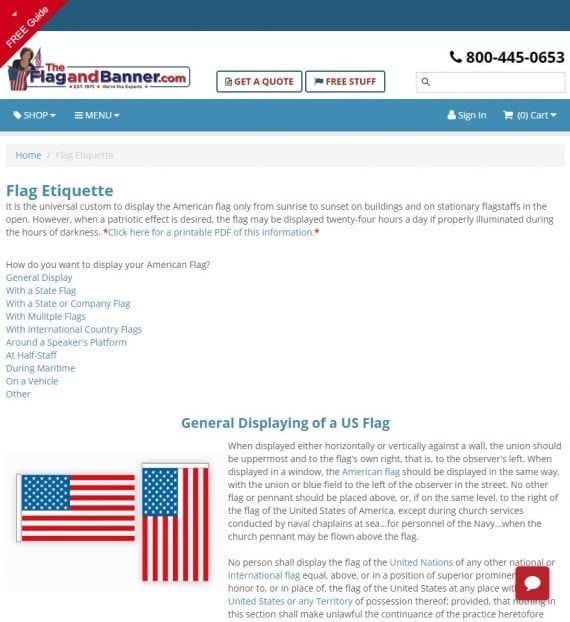
    Flag and Banner's etiquette page details how to display the U.S. flag properly.
    If blogs take too much effort to sustain, consider a fact-based educational guide such as the one above from flag purveyor Flag and Banner. These resources typically stay current for long periods, requiring only occasional updating.
    Flag and Banner's guide ranks well in organic search because it's thorough and contains illustrations that help shoppers understand how to display each flag type.
    I've never encountered an ecommerce business that lacked educational topics. With practice, you'll find topics everywhere. A question from a shopper could be a topic. Info from a manufacturer might be a topic. Keep your eyes open for learning opportunities, and you'll never be short of topics to write about.
    When you have more than one article in your resource section, create a hub-and-spoke model with a category-level page (the hub) that links to all of the resource pages (the spokes) logically.
    How-to Guides ecommerce content how-to example
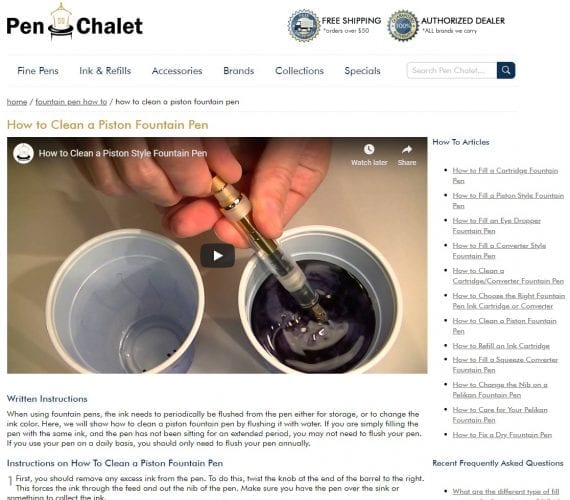
    Pen Chalet' s how-to guides offer videos and step-by-step instructions with images.
    How-to guides tend to be broken out into steps or sections. If a page could be titled "How to…," "10 Steps to…," or "10 Tips to…," you're probably looking at a how-to guide.
    The image above shows a guide on how to clean a piston fountain pen, featuring a video and written instructions with still images in a traditional step-by-step format. With the rise of Google's answer boxes, guides are an excellent way to increase brand visibility.
    Consumers increasingly prefer videos for how-to content. Regardless, both text and video content can be arranged in the hub-and-spoke model described above.
    FAQs ecommerce FAQ content example
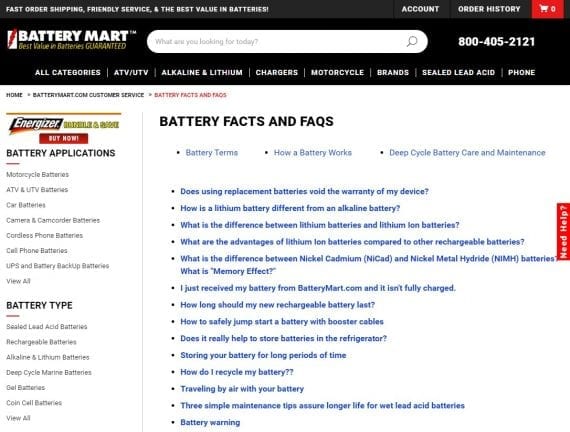
    Battery Mart's FAQ section answers common questions from shoppers.
    Many sites have a section for frequently asked questions — FAQs. These snippets tend to answer purely transactional questions such as shipping speed and return policy.
    But the Battery Mart example above shows an FAQ relevant to its product offerings.
    FAQs are the strongest for SEO when each question links to a separate page for the answer. That enables each question-and-answer pair to be optimized individually. FAQs with all of the answers on a single page have more difficulty ranking.
    Support Information ecommerce support content example
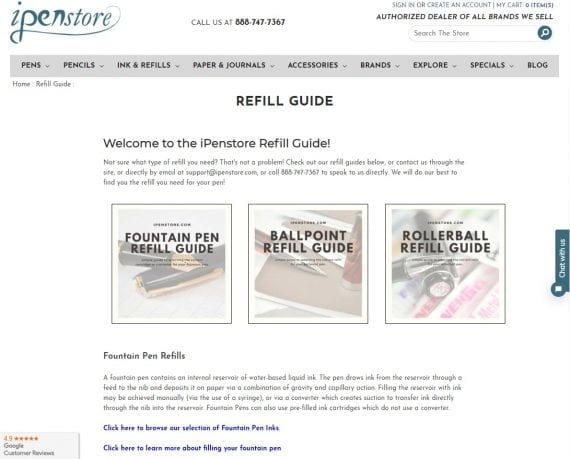
    The r efill guide at iPenstore directs shoppers to the parts they need.
    Search engines are also likely to rank content that answers searchers' informational intent queries. As a niche ecommerce business, iPenstore doesn't need a huge support section. Its refill guide, above, likely siphons off calls to its customer service hotline — that's the point, after all. It allows customers to find answers for product-related questions without picking up the phone.
    Unfortunately, businesses don't usually value or fund their support sections. Support content can be a way to snare new shoppers as well as entice lapsed customers back — if the experience is positive.
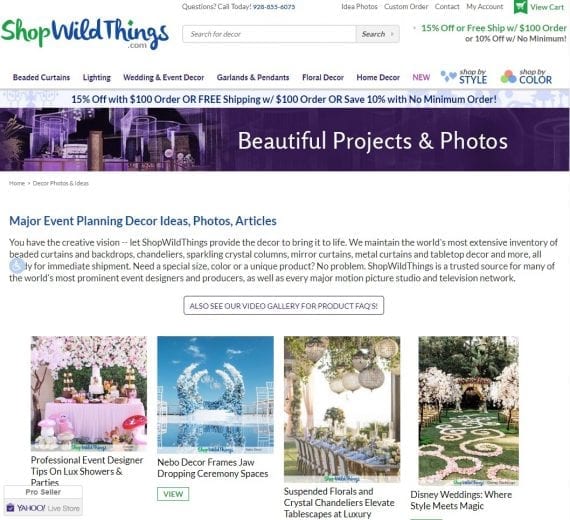
    Idea Galleries ecommerce idea gallery example
    ShopWildThings wraps strong textual content around beautiful photography.
    Businesses frequently waste the SEO potential of idea galleries by pasting a ton of images on a page with no supporting text. Without the expert commentary to provide context and pointers for executing the idea successfully, pretty pictures don't provide value — not for shoppers and certainly not for SEO.
    In the example above, ShopWildThings, an ecommerce business offering wedding and event décor, successfully merges ideas with the blog concept. The articles feature photos from customers, often by professional photographers. The text around the images describes how the products were used to achieve the look in the photo. Because it's also natural to provide helpful links to those products, it's a compelling way to increase internal linking.

    Friday, September 13, 2019

    Search Engine Optimization is one of those "things" that not many people grasp. They might know what it is, and its importance, but they probably wouldn't know where to start if they had to go about practicing or implementing it. That's where SERPstash comes in handy.
    According to a recent report from research firm Clutch, approximately 83 percent of large-scale digital marketing outfits say they believed they were doing a good job achieving their respective goals. But, 44 percent said SEO was their "least popular" tool.
    READ: New Android phone? Do this first!
    Why the disconnect? It's likely because it's not as easy as people think. Sometimes gaming a system isn't as easy as playing a game.
    Don't be the guy who drops the ball in the area of SEO. Whether for yourself, or for your company, you need resources and tools, and you need to use them.
    We're currently offering an all-you-need account with those exact tools: A lifetime subscription to SERPstash Premium service. Available right now for just $24 (over 90 percent off), it's your answer to SEO prayers.
    SERPstash automatically analyzes your message and content, identifying top-performing keywords and auditing your pages for what you're doing — right and wrong. Moreover, it suggests keywords to fit your content as well as tips for optimization.
    Features
  • Analyze & filter ranking keywords related to your industry
  • Discover who is ranking for the same keywords that you decide to target
  • Find the top 100 highest quality websites linking back to your website & who is linking to your competitors
  • Improve your site's speed w/ simple tests & insights from Google
  • Find your site's current ranking on Google & Bing
  • Identify indexed pages, top queries & backlinking pages
  • Test whether or not your pages are considered "mobile-friendly" on Google search results

  • You'll have access to nearly two dozen different tools to boost your site speed, find opportunities for improved indexing and backlinking, and more.
    SERPstash even dials in on your key competitors for deeper insight, pulling in the tricks helping them find success. You'll know where you really stand in Google search rankings, what's bringing you traffic, and the tools to land your site in Google's prized top search results.
    A year of SERPstash Premium coverage typically costs about $500, but you can take advantage of a limited time price drop and get it all for $24. Best of all, it's yours for as long as you want.
    Save even more!
    In addition to the savings above, when you buy through AndroidGuys Deals, for every $25 spent, you get $1 credit added to your account. What's more, should you refer the deal via social media or an email that results in a purchase, you'll earn $10 credit in your account.
    If this is your first time buying, then you are also eligible for a further 10% discount when you subscribe for email updates.
    How about a freebie?
    Not looking to spend any money today? That's alright, we understand. Why not visit the AndroidGuys section for freebies and take something anyhow? Go ahead, grab two!
    Nearly 15 years ago, the nofollow attribute was introduced as a means to help fight comment spam. It also quickly became one of Google’s recommended methods for flagging advertising-related or sponsored links. The web has evolved since nofollow was introduced in 2005 and it’s time for nofollow to evolve as well.
    Today, we’re announcing two new link attributes that provide webmasters with additional ways to identify to Google Search the nature of particular links. These, along with nofollow, are summarized below:

    rel="sponsored": Use the sponsored attribute to identify links on your site that were created as part of advertisements, sponsorships or other compensation agreements.

    rel="ugc": UGC stands for User Generated Content, and the ugc attribute value is recommended for links within user generated content, such as comments and forum posts.

    rel="nofollow": Use this attribute for cases where you want to link to a page but don’t want to imply any type of endorsement, including passing along ranking credit to another page.

    When nofollow was introduced, Google would not count any link marked this way as a signal to use within our search algorithms. This has now changed. All the link attributes -- sponsored, UGC and nofollow -- are treated as hints about which links to consider or exclude within Search. We’ll use these hints -- along with other signals -- as a way to better understand how to appropriately analyze and use links within our systems.
    Why not completely ignore such links, as had been the case with nofollow? Links contain valuable information that can help us improve search, such as how the words within links describe content they point at. Looking at all the links we encounter can also help us better understand unnatural linking patterns. By shifting to a hint model, we no longer lose this important information, while still allowing site owners to indicate that some links shouldn’t be given the weight of a first-party endorsement.
    We know these new attributes will generate questions, so here’s a FAQ that we hope covers most of those.

    Do I need to change my existing nofollows?
    No. If you use nofollow now as a way to block sponsored links, or to signify that you don’t vouch for a page you link to, that will continue to be supported. There’s absolutely no need to change any nofollow links that you already have.

    Can I use more than one rel value on a link?
    Yes, you can use more than one rel value on a link. For example, rel="ugc sponsored" is a perfectly valid attribute which hints that the link came from user-generated content and is sponsored. It’s also valid to use nofollow with the new attributes -- such as rel="nofollow ugc" -- if you wish to be backwards-compatible with services that don’t support the new attributes.

    If I use nofollow for ads or sponsored links, do I need to change those?
    No. You can keep using nofollow as a method for flagging such links to avoid possible link scheme penalties. You don't need to change any existing markup. If you have systems that append this to new links, they can continue to do so. However, we recommend switching over to rel=”sponsored” if or when it is convenient.

    Do I still need to flag ad or sponsored links?
    Yes. If you want to avoid a possible link scheme action, use rel=“sponsored” or rel=“nofollow” to flag these links. We prefer the use of “sponsored,” but either is fine and will be treated the same, for this purpose.

    What happens if I use the wrong attribute on a link?
    There’s no wrong attribute except in the case of sponsored links. If you flag a UGC link or a non-ad link as “sponsored,” we’ll see that hint but the impact -- if any at all -- would be at most that we might not count the link as a credit for another page. In this regard, it’s no different than the status quo of many UGC and non-ad links already marked as nofollow.
    It is an issue going the opposite way. Any link that is clearly an ad or sponsored should use “sponsored” or “nofollow,” as described above. Using “sponsored” is preferred, but “nofollow” is acceptable.

    Why should I bother using any of these new attributes?
    Using the new attributes allows us to better process links for analysis of the web. That can include your own content, if people who link to you make use of these attributes.

    Won’t changing to a “hint” approach encourage link spam in comments and UGC content?
    Many sites that allow third-parties to contribute to content already deter link spam in a variety of ways, including moderation tools that can be integrated into many blogging platforms and human review. The link attributes of “ugc” and “nofollow” will continue to be a further deterrent. In most cases, the move to a hint model won’t change the nature of how we treat such links. We’ll generally treat them as we did with nofollow before and not consider them for ranking purposes. We will still continue to carefully assess how to use links within Search, just as we always have and as we’ve had to do for situations where no attributions were provided.

    When do these attributes and changes go into effect?
    All the link attributes, sponsored, ugc and nofollow, now work today as hints for us to incorporate for ranking purposes. For crawling and indexing purposes, nofollow will become a hint as of March 1, 2020. Those depending on nofollow solely to block a page from being indexed (which was never recommended) should use one of the much more robust mechanisms listed on our Learn how to block URLs from Google help page.

    Posted by Danny Sullivan and Gary
    Gone are the days when a single tweak in the content or the title tag was able to get your site to the top of the search results.
    Google algorithm is now much harder to crack than before. Besides, 75 percent of online users do not scroll past the first page of the search engine results.
    As you can imagine, this makes the SEO space highly competitive right now and companies can no longer rely on basic techniques.
    However, you can always make sure that the odds are in your favor by using data science.
    What is data science?
    A combination of various tools, algorithms, and machine learning principles designed to unveil hidden patterns using the raw data is referred to as data science.
    Data science is creating its impression across every domain. As cited by Maryville University, around 1.7 megabytes of data will be generated every second for everyone on the planet by the end of 2020.
    Why do you need it?
    Data science provides valuable insights about a website's performance and these insights can help you improve your SEO campaigns.
    Data science is used to make predictions about upcoming trends and customer behavior using analytics and machine learning. For example, Netflix uses insight from data science to produce its original series that drives user interest.
    Apart from identifying opportunities, data science also handles high voluminous data and helps in making better decisions. Businesses can easily gauge the effectiveness of a marketing campaign with the help of data science.
    How does data science help SEO?
    Data science helps you make concrete decisions by letting you:


  • Visualize which combinations have the potential to make the biggest impact
  • Create marketing campaigns aligned with the needs of their audience
  • Understand buyer's preferences and identify pain points
  • Identify referral sources of converting traffic
  • Verify loading time, indexing, bounce rate, response errors, and redirects
  • Verify the most and least crawled URLs
  • Identify pages that crawlers aren't supposed to index
  • Identify sources of unusual traffic
  • How do you apply data science to your SEO data?
    Follow the below ways to apply data science to your SEO campaigns:
    1. Select your data sources
    Understand that the quality of your data sources directly impacts your data insights. You need the right tools to track important metrics more precisely. The top four tools that can help you gather the right data and make better decisions are Google Analytics, SEMrush, and Ahrefs.
    2. Think "ecosystem" instead of "data" and "tools" 
    Do not rely on one solution if your SEO is complex and integrates with various other digital marketing areas like content marketing, CX management, CRO, and sales. The "data science" approach to SEO is about integrating methods, tools, and practices in a way that draws deep and accurate insights from the cumulative data mix. Consider the SEMRush console we discussed above. The traffic stats it presents work on the assumption that all traffic is genuine. What if there are bad bots at play here? It makes a lot of sense to bring in a traffic quality checking tool into the mix, something like what Finteza does.
    Example of using Finteza to improve SEO using data science
    Source: Finteza
    It offers you advanced bot detection tech, along with a whole suite of conversion funnel optimization modules, to help you not only make more sense of your data but also to put the insight into action, to drive business KPI scores.
    3. Align SEO with marketing initiatives 
    Backing your SEO with other marketing initiatives makes it stronger. Collaborate with sales, developers, UX designers, and customer support teams to optimize for all search ranking factors.
    Use data science to determine a universal set of SEO best practices each team can follow to achieve your goal. Try tracking the evolving relationships between independent and dependent variables to get a better idea of what actions are important to your business. To fully understand how your SEO affects other channels, capture and analyze data from:


  • Top conversion paths
  • Conversions and assisted conversions

  • Gain a clear understanding of your customers' journeys to establish a stronger alignment between various marketing activities and attribute the outcomes to separate campaigns easily.
    4. Visualize with data science
    Find it hard to digest numbers piled onto a spreadsheet? Taking a hierarchical approach to your data can cause you to miss out on important hidden between the lines. On the other hand, draw different benefits from data visualizations like:


  • Compare and contrast
  • Process large data volumes at scale
  • Accelerate knowledge discovery
  • Reveal hidden questions
  • Spot common patterns and trends

  • Test it out yourself. Leverage data science during an SEO technical audit and receive insights about your site's health and performance. Use that data to know more about your page authority, rankings, number of outbound/inbound links per page, and other factors. However, you won't find a proper answer about why some pages perform better in the search results, while the others lag behind. Visualizing the site's internal link structure and figuring out the domain authority of individual pages on a scale of one to ten (like Google) allows you to see the areas for improvement and adopt proactive measures.
    On-page SEO optimization is just a single example of how SEO experts combine visualizations with data science to provide better results to clients. Make your SEO data more actionable with visualizations.
    5. Take help of A/B testing
    LinkedIn carried out an experiment using the XNLT platform. The experiment was focused on the redesign of the "Premium Subscription" payment flow. The LinkedIn UX team reduced the number of payment checkout pages and added a FAQ. The results were impressive with an increase in the number of annual bookings which was worth millions of dollars, a 30% reduction in refund orders and a 10% increase in free trial subscriptions.
    Concluding remarks
    Data science focuses on eliminating guesswork from SEO. Rather than presuming what works and how a specific action affects your goals, use data science to know what's bringing you the desired results and how you're able to quantify your success. Brands like Airbnb are already doing it and so can you.
    Joydeep Bhattacharya is a digital marketing evangelist and author of the SEO Sandwitch blog.
    Related reading
    In the data set that I used businesses were found via non-branded searches 70% of the time vs. 30% of the time via a branded search.
    A marketing feedback loop is when a business uses responses they get from a campaign or product on the social web. Ways to identify and use it to improve SEO.
    In a world of highly customized SERPs and a host of ranking signals for local search that Google uses, relevant ranking data is as challenging.
    Keyword research can be stressful. This guide explains the process of researching keywords to help you begin and improve your content marketing strategy.