Wednesday, September 11, 2019

Sign up for our daily recaps of the ever-changing search marketing landscape.
Note: By submitting this form, you agree to Third Door Media's terms. We respect your privacy.
Google updated its Search Quality Rater Guidelines on September 5; the update was first brought to the attention of the SEO community via a tweet from SEM consultant Marie Haynes. This latest version places more emphasis on vetting news sources as well as YMYL content and its creators and expands the basis for which a rater might apply the lowest ratings to content that may potentially spread hate. The previous update occurred on May 16.
Below is an analysis of the changes. The May 16 version of the guidelines appears on the left-hand side of the screenshots, with the corresponding section of the latest version on the right-hand side.
2.3: Your Money or Your Life (YMYL) Pages
Addition of the word "topics," broadening the content that this section may pertain to beyond web pages.
The previous "News articles or public/official Information pages Important for having an Informed citizenry" and the "Legal Information pages" sections have been reorganized and replaced with "News and current events" and "Civics, government, and law," which now appear at the top of the list.
"News and current events" features examples of news that may not necessarily be considered YMYL. The term "voting" is explicitly mentioned in the new "Civics, government, and law" section.
"Shopping" and "Finance" are now two separate categories. "Shopping" YMYL content now includes "information about or services related to research or purchase of goods/services," such as reviews.
"Groups of people" is also a new section; the description could be interpreted as pertaining to hate groups, solidarity groups or anything in between.
The "Other" section now also provides more examples of content that could be considered YMYL.
2.5.2 Finding Who is Responsible for the Website and Who Created the Content on the Page
This subsection of 2.5 (Understanding the Website) adds "Websites want users to be able to distinguish between content created by themselves versus content that was added by other users." For users, being able discern between in-house and third-party content may affect the publisher's reputation. For example, lyrics website Genius accused Google of stealing its content; only then did Google disclose that it licenses lyrics from third parties.
The final sentence of the subsection increases the responsibility borne by websites that syndicate content from just having to possess the appropriate licenses to now also potentially being held accountable for the quality of that licensed content.
2.6.1 Research on the Reputation of the Website or Creator of the Main Content
This subsection of 2.6 (Reputation of the Website or Creator of the Main Content) puts more emphasis on print media by replacing "newspaper website" with "newspaper (with an associated website)." It also allows search quality raters to take a track record of high-quality, original reporting into account — not just awards won by a publication.
4.6 Examples of High Quality Pages
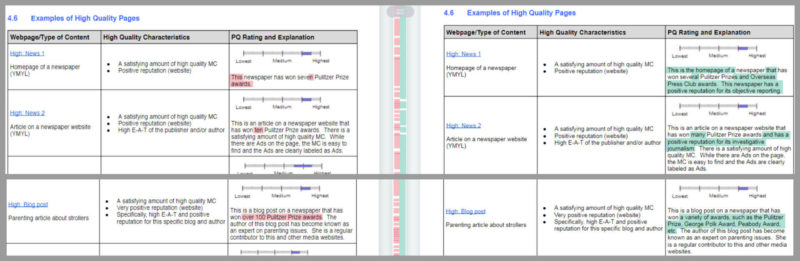
The Page Quality (PQ) Rating and Explanation sections of three examples have been expanded. In line with the additions from 2.6.1 above, the news explanations now include having a positive reputation for objective reporting and investigative journalism.
Overall, the guidelines seem to be moving away from Pulitzers as the be all, end all of awards and are instructing raters to acknowledge other accolades as well.
5.0 Highest Quality Pages
Section 5.1 (Very High Quality Main Content) now expands YMYL topics outside the bounds of news articles and information pages. There are now criteria for news, artistic and informational content.
Section 5.2 (Very Positive Reputation) removes the reference to E-A-T and reminds raters to carefully check the reputation of YMYL content creators.
Section 5.3 (Very High Level of E-A-T) raises the overall bar for YMYL content, but acknowledges that standards for E-A-T will vary. It also adds video as a content source.
5.4 (Examples of Highest Quality Pages) now features two examples of high-quality news, with explanations that emphasize awards, high-quality main content, uniqueness, originality, depth and investigative journalism.
The "Highest: Entertainment" example is not present on the latest iteration of the guidelines.
The explanations for three high-quality video examples have been expanded to include uniqueness and originality.
6.7 Examples of Low Quality Pages
Four examples from this section now carry the YMYL label.
7.3 Pages That Potentially Spread Hate
"Criteria" has been removed and replaced with broader bases for applying the lowest page rating. There is also a stronger emphasis on groups.
11.0 Page Quality Rating FAQs
Google has made it more explicit to its raters that pages existing for the sake of artistic expression, humor, entertainment and the like are "all valid and valued page purposes," and thus may not necessarily deserve a low quality rating because they do not serve more practical purposes.
12.9 Rating on Your Phone Issues
Google is no longer telling raters to assume, by default, that queries with device-specific results were issued on an Android device.
13.2.1 Examples of Fully Meets (FullyM) Result Blocks
The note once-attached to this explanation has been removed. This is in line with abandoning the assumption that device-specific results are coming from Android devices (mentioned above in 12.9).
13.5.1 Examples of Slightly Meets (SM) Result Blocks
The "ellen degeneres" example has been removed.
13.6 Fails to Meet (FailsM)
The "zoo atlanta" example has been removed.
14.6.1 Using the Upsetting-Offensive Flag

As with section 7.3, the word "criteria" has been removed, allowing for a wider bases with which to justify applying the Upsetting-Offensive flag. There is also additional emphasis on groups of people.
About The Author George Nguyen is an Associate Editor at Third Door Media. His background is in content marketing, journalism, and storytelling.
Sign up for our daily recaps of the ever-changing search marketing landscape.
Note: By submitting this form, you agree to Third Door Media's terms. We respect your privacy.

Tuesday, September 10, 2019

That Apple has used its App Store to offer itself a competitive advantage is nothing new. TechCrunch and others have been reporting on this problem for years, including those times when Apple chose to display its apps in the No. 1 position on the Top Charts, for example, or when it stole some of the App Store's best ideas for its own, bann ed apps that competed with iOS features or positioned its apps higher than competitors in search. Now, in the wake of antitrust investigations in the U.S. and abroad, as well as various anti-competitive lawsuits, Apple has adjusted the App Store's algorithm so fewer of its own apps would appear at the top of the search results.

The change was reported by The New York Times on Monday, which presented Apple with a lengthy analysis of app rankings.

It even found that some searches for various terms would display as many as 14 Apple-owned apps before showing any results from rivals. Competitors could only rank higher if they paid for an App Store search ad, the report noted.

That's a bad look for Apple, which has recently been trying to distance itself and its App Store from any anti-competitive accusations.

In May, for example, Apple launched a new App Store website designed to demonstrate how it welcomes competition from third-party apps. The site showed that for every Apple built-in app, there were competitors available throughout the App Store.

But availability in the store and discoverability by consumers are two different things.

Apple admitted to the NYT that for over a year many common searches on the App Store would return Apple's own apps, even when the Apple apps were less popular or relevant at times. The company explained the algorithm wasn't manipulated to do so. For the most part, Apple said its own apps ranked higher because they're more popular and because they come up in search results for many common terms. The company additionally said that one feature of the app's algorithm would sometimes group apps by their maker, which gave Apple's own apps better rankings than expected.

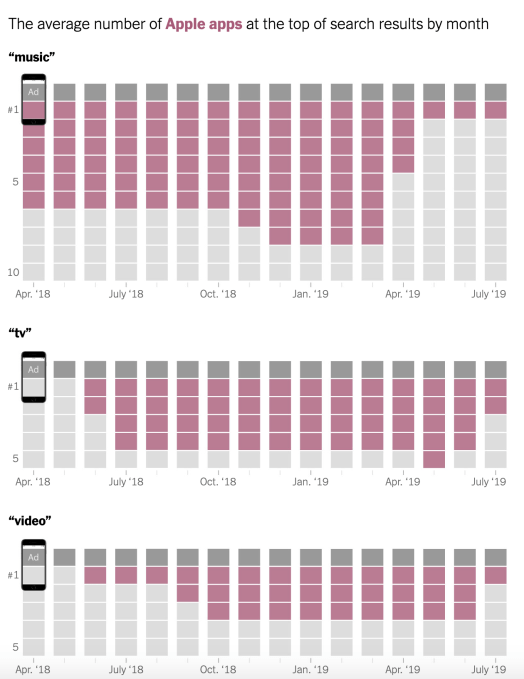
Screen Shot 2019 09 09 at 11.29.20 AM

Above: via the NYT, the average number of Apple apps that returned at the top of the search results by month

Apple said it adjusted the algorithm in July to make it seem like Apple's own apps weren't receiving special treatment. According to the NYT, both Apple VP Philip Schiller, who oversees the App Store, and SVP Eddy Cue, who oversees many of Apple's apps, confirmed that these changes have not fully fixed the problem.

The issue, as Apple explains it, is that its own apps are so popular that it had to tweak its algorithm to pretend they are not. Whether or not this is true can't be independently verified, however, as Apple doesn't allow any visibility into metrics like searches, downloads or active users.

Maybe it's time for Apple's apps to exit the App Store?

The report, along with the supposed ineffectiveness of the algorithm's changes, begs the question as to whether Apple's apps should show up in the App Store's charts and search results at all, and if so, how.

To be fair, this is a question that's not limited to Apple. Google today is facing the same problem. Recently, the CEO of a popular software program, Basecamp, called Google's paid search ads a "shakedown," arguing that the only way his otherwise No. 1 search result can rank at the top of the search results page is to buy an ad. Meanwhile, his competitors can do so — even using his brand name as the keyword to bid against.

The same holds true for the App Store, but on a smaller scale than the entirety of the web. That also makes Apple's problem easier to solve.

For example, Apple could simply choose to offer a dedicated section for its own software downloads, and leave the App Store as the home for third-party software alone.

This sort of change could help to eliminate concerns over Apple's anti-competitive behavior in the search results and chart rankings. Apple might balk against this solution, saying that users should have an easy way to locate and download its own apps, and the App Store is the place to do that. But the actual marketplace itself could be left to the third-party software while the larger App Store app — which today includes a variety of app-related content, including app reviews, interviews with developers, app tips and a subscription gaming service, Apple Arcade — could still be used to showcase Apple-produced software.

It could just do so outside the actual marketplace.

Here's how this could work. If users wanted to re-install an Apple app they had deleted or download one that didn't come pre-installed on their device, they could be directed to a special Apple software download page. Pointers to this page could be in the App Store app itself as well as in the iOS Settings.

An ideal spot for this section could even be on the existing Search page of the App Store.

With a redesign, Apple could offer a modified search screen where users could optionally check a box to return a list of apps results that would come only from Apple. This would indicate intentional behavior on the consumer's part. That is, they are directly seeking an Apple software download — as opposed to the current situation where a user searches for "Music" and sees Apple's own music app appear above all the others from rivals like Spotify and Pandora.

Alternately, Apple could just list its own apps on this page or offer a link to this dedicated page from the search screen.

And these are just a few variations on a single idea. There are plenty of other ways the App Store could be adjusted to be less anti-competitive, too.

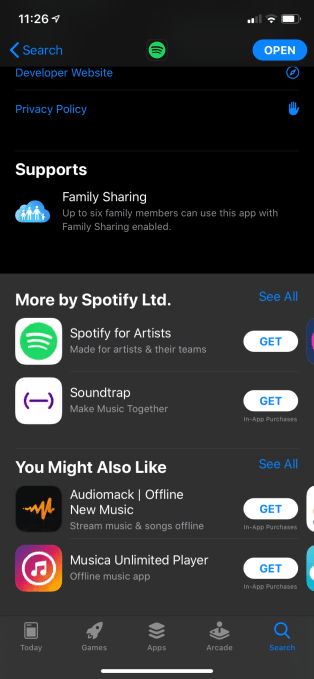
As another example, Apple could also include the "You Might Also Like" section in its own apps' App Store listings, as it does for all third-party apps.

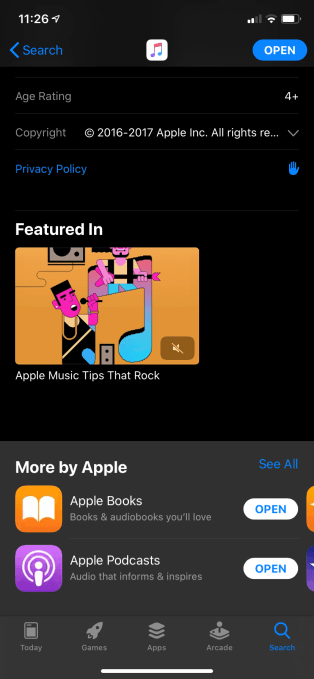
Image from iOS 1Above: Apple Music's App Store Listing

This section directs users to other apps that match the same search query right within the app's detail page. Apple's own apps, however, only include a "More by Apple" section. That means it's keeping all the search traffic and consumer interest for itself.

Image from iOS

Above: Spotify's App Store Listing

Or it could reduce the screen space dedicated to its own apps in the search results — even if they rank higher — in order to give more attention to apps from competitors while still being able to cater to users who were truly in search of Apple's software.

But ultimately, how Apple will have to behave with regard to its App Store may be left to the regulators to decide, given Apple's failure to bake this sort of anti-competitive thinking into its App Store design.

Google's John Mueller answered how long it takes to recover from the June 2019 broad core algorithm update. He offered four takeaways related to how to recover from a broad core algorithm update.
Key Insights on Google Core Algorithm Updates
  • Pages that lost traffic are not penalized
  • Core update is about pages ranking better if they're more relevant (or losing ranking if less relevant)
  • Don't have to wait until the next core update to recover
  • It's not generally about spam
  • How Long to Recover from a Google Broad Core Algorithm Update?
    The person asking the question incorrectly mentioned "GoogleBot" making a decision as to when a site can recover from a core update. Googlebot is just a software program that downloads web pages, what's known as a crawler.
    It is Google's algorithm back at the data centers that ranks all the downloaded web pages. It is those algorithms that are updated in a Core Algorithm Update.
    Here is the question:
    "Got hit by the June Core Update. We're now working on quality content. How many months do I have to wait for a recovery? Can Googlebot decide to remove a penalty without any core update?"
    Broad Core Algorithm Updates are Not Penalties
    John Mueller answered:
    "First of all, a core update is not a penalty. It's not a matter of the Google algorithm saying this is a bad website."
    Losing rankings after a Core Algorithm Update can feel like being penalized. The effect is the same. But it's not the same.
    In a penalty Google sends the publisher a notice through Google's Search Console about Webmaster Guideline violations.
    There are no such notices when you lose rankings after a core algorithm update.
    What John Mueller is communicating is that this is not about the publisher doing something bad, like violating Google's publisher guidelines,  for example a content or link spam issue.
    Why Sites Lose Rankings in Core Algorithm Updates
    John Mueller goes on to discuss why sites lose rankings. He explains that the reason sites lose rankings is because Google's new algorithm has decided that certain sites are more relevant.
    Here is what John Mueller said about core updates and sites that gain or lose rankings:
    "It's essentially just saying, from the way that we determine which pages are relevant, we've kind of changed our calculations and found other pages that we think are more relevant.
    So it's not a matter of doing anything wrong and then you fix it (and then Google recognizes it and shows it properly).
    …More it's a matter of well we didn't think these pages were as relevant as they originally were. And these kinds of changes they can happen over time."
    What Are Google Broad Core Algorithm Updates? Kinds of Update Ranking Losses
    Although Mueller didn't mention it, during the course of conducting site reviews, I have seen there are at least two kinds of core algorithm update losses.
    Search Ranking Position LossesIn the first scenario, some sites will gain positions, causing previously high ranked pages to lose those positions in the search results.
    Complete Ranking LossesThe second scenario is when a site completely loses rankings. This is more serious and generally requires a deep look at the SERPs.
    Official Google Guidance
    Mueller then made reference to an August 2019 blog  post in which Google offered core algorithm update guidance.
    "We have a whole blog post that goes into fairly well detail on what we look at with regards to these core updates. so I would double check that."
    How Long to Wait for Recovery from Ranking Losses
    Lastly, John Mueller answered that Google's algorithm is constantly updating. That means you don't have to wait until the next core algorithm update to see if improvements to your web pages have helped. You should see ranking improvements sooner.
    John didn't mention it in his answer, but there are cases when rankings return after a subsequent algorithm update. That could be because some updates tend to be overly broad, affecting sites they didn't intend to affect. So they might fine tune whatever change they made.
    So if you see your rankings return after a core algorithm update, it's likely that's because they pulled back on some of the changes.
    Here's John Mueller's comment:
    "With regards to kind of seeing changes in one core update and when would you see the next batch of changes if you make significant effort to improve your website for example, in general this is something that happens on an ongoing basis.
    So on the one hand we have the core updates which are kind of bigger changes in our algorithm. And on the other hand we have lots of small things that keep changing over time.
    The whole Internet changes over time and with that our search results are essentially changing from day to day and they can improve from day to day as well.
    So if you've been making significant improvements on your website then you should see these kinds of subtle changes over time as well. So it's not a matter of waiting for a specific change to see those changes in effect."
    Core Algorithm Ranking Losses are Not Always About Quality
    Mueller ended his response by repeating that a rankings loss is not a sign that something bad happened to your site.
    "But again, these core updates are not a sign that there's anything bad on your website."
    Takeaways on Recovering from a Google Algorithm Update
    There are some who view every update as being about quality. When a site loses rankings, they point their finger and say it must be a low quality issue.
    Others tend to see ranking issues as a matter of technical issues. Your site is slow, your redirects are chained and so on.
    Quality and technical issues are legitimate concerns for ranking a site. Those issues must be addressed. But that's not generally what these core algo updates are about.
    When a site loses rankings after a core update, while technical and quality issues may exist, I prefer to keep an open mind and review everything to make sure that everything that could possibly contribute to a low ranking is addressed, especially relevance factors.
    John Mueller's statement about relevance factors is so important that he stated it twice.
    If your site lost rankings in a core algo update, you may find quality and technical issues that need improvement. But in my experience auditing websites that lost rankings, it may be useful to investigate the relevance factors.
    Watch the Google Webmaster Hangout here:https://youtu.be/4oPYM01FJgA?t=347
    More Resources

    The mid-range phone market can be difficult to navigate. While cheap phones are getting better all the time, it's tough to decide how much you need to spend to get the right phone for you. Motorola, Nokia, and Google are not about to make things any easier. The impressive Motorola One Zoom is a big, stylish beauty with a quad lens camera for $450; the Nokia 7.2 comes close to matching it on the spec sheet, but costs $100 less; while Google's budget option, the Pixel 3a, lands in the middle at $400. Which one should you pick? Let's take a closer look and find out.

    Specs Motorola One Zoom Nokia 7.2 Google Pixel 3a  Size 158 × 75 × 8.8 mm (6.22 × 2.95 × 0.35 inches) 159.9 × 75.1 × 8.3 mm (6.29 × 2.96 × 0.32 inches) 151.3 × 70.1 × 8.2mm (6.0 × 2.8 × 0.3 inches) Weight 190 grams (6.7 ounces) 180 grams (6.35 ounces) 147 grams (5.18 ounces) Screen size 6.39-inch OLED display 6.3-inch PureDisplay IPS LCD 5.6-inch OLED display Screen resolution 2,340 × 1,080 pixels (403 pixels-per-inch) 2,340 × 1,080 pixels (409 pixels-per-inch) 2,220 × 1,080 pixels (441 pixels-per-inch) Operating system Android 9.0 Pie Android 9.0 Pie Android 10 Storage space 128GB 128GB 64GB MicroSD card slot Yes Yes No Tap-to-pay services (NFC) Google Pay Google Pay Google Pay Processor Qualcomm Snapdragon 675 Qualcomm Snapdragon 660 Qualcomm Snapdragon 670 RAM 4GB 4GB  4GB Camera Quad lens 48-megapixel, 8MP telephoto, 16MP wide-angle, and 5MP rear, 25MP front Triple lens 48-megapixel, 8MP wide-angle, and 5MP rear, 20MP front Single-lens 12.2-megapixel rear, 8-megapixel front Video 2,160p at 30 fps, 1,080p at 60 fps 2,160p at 30 fps, 1,080p at 60 fps 2,160p at 30 frames per second, 1080p at 120 fps, 720p at 240 fps Bluetooth version Bluetooth 5.0 Bluetooth 5.0 Bluetooth 5.0 Ports USB-C, 3.5mm audio jack USB-C, 3.5mm audio jack USB-C, 3.5mm audio jack Fingerprint sensor Yes (in-display) Yes (back) Yes (back) Water resistance Splash and dust resistant Splash resistant Splash and dust resistant Battery 4,000mAh

    Fast charging 15W

    3,500mAh

    Fast charging 18W

    3,000mAh

    Fast charging 18W

    App marketplace Google Play Store Google Play Store Google Play Store Network support AT&T and T-Mobile AT&T and T-Mobile T-Mobile, AT&T, Verizon, Sprint Colors Electric Gray, Cosmic Purple, Brushed Bronze Charcoal, Cyan Green, Ice Just Black, Clearly White, Purple-ish Price $450 $350 $400 Buy from Motorola Nokia Google, Best Buy, Sprint, Verizon, U.S. Cellular, T-Mobile, Visible Review score Hands-on Hands-on 4.5 out of 5 stars Performance, battery life, and charging motorola one zoomJulian Chokkattu/Digital Trends

    These phones divide neatly on performance just as you'd expect from the price tags. The most expensive of the bunch, the Motorola One Zoom has the fastest processor in the shape of Qualcomm's Snapdragon 675, the Pixel 3a has the Snapdragon 670, and the Nokia 7.2 has the Snapdragon 660. The difference is relatively small, the 675 is perhaps 20% faster than the 660. They each have 4GB of RAM. The Motorola and Nokia phones are evenly matched on storage with 128GB and room for a MicroSD card, but the Pixel lags behind with 64GB and no MicroSD card slot.

    With a 3,000mAh capacity, the Google Pixel 3a has the smallest battery of the bunch, but it still lasted 9 hours and 12 minutes in our battery test and will see you through the day. The Nokia 7.2 has a bigger screen which may cancel out the extra 500mAh, but with a 4,000mAh battery, we would expect the Motorola One Zoom to have the most stamina. They all offer some form of fast charging, though there isn't much difference in speed. There's no wireless charging support here.

    Winner: Motorola One Zoom

    Design and durability

    The Motorola One Zoom is the stand out here, especially the Cosmic Purple model, which boasts a really eye-catching design with gentle curves and a subtle micro-texture in the glass back. Motorola has dealt with the camera suite cleverly, by hosting it in a central, rounded lozenge with the M logo which is also an LED light that comes to life when you have notifications. The Nokia 7.2 is clearly updated over last year's Nokia 7.1, but it feels a step behind with a round camera module and a recessed fingerprint sensor below. The Pixel 3a is bottom of the pack again here with a plastic back, rather than glass, and a single lens at the top left with a central, recessed fingerprint sensor.

    Around front the Motorola and the Nokia are very similar with a teardrop notch at the top to accommodate the front-facing camera and a fairly slim bezel at the bottom. The Pixel 3a has big bezels by comparison. The Pixel 3a is also much smaller than the other two, which may suit some people, though you can also opt for the Pixel 3a XL at $480 if you prefer a larger phone. All three have a headphone jack, but only the Motorola has an in-display fingerprint sensor, though this isn't necessarily an advantage as it's an optical sensor and they're generally not as reliable.

    They're all splash resistant, so fine with rain, but not to be dunked. The Nokia has a special plastic body that's supposed to be stronger than polycarbonate, but it's still a glass sandwich. The Pixel 3a may prove a little more durable because of the plastic back, but cases are advisable for each.

    Winner: Motorola One Zoom

    Display Motorola One Zoom fingerprint sensorJulian Chokkattu/Digital Trends

    The Motorola One Zoom has the biggest display here at 6.39 inches, and it's an OLED with deep blacks and accurate colors. The Nokia 7.2 has a 6.3-inch LCD display and, while it can't match the deep blacks of OLED, it is bright, sharp, and HDR10 certified — it even upscales standard content to boost the contrast and enrich the colors. The Google Pixel 3a has a 5.6-inch OLED that's sharp and bright, though the colors may be a little more saturated than they should be. If a big screen is a must, you could jump up to the Pixel 3a XL, though it still tops out at 6 inches. These are all good screens for the money, but the Motorola edges a narrow win.

    Winner: Motorola One Zoom

    Camera Pixel-3a-XL-time-lapseJulian Chokkattu/Digital Trends

    On paper, this contest appears clear cut, but there's a lot more to a camera than the megapixel count. The Motorola One Zoom has an embarrassment of hardware riches with a 48-megapixel main lens, an 8-megapixel telephoto lens for zooming in, a 16-megapixel wide-angle lens, and a 5-megapixel lens for depth measurements. It also packs in a 25-megapixel lens around the front. The Nokia 7.2 isn't too far behind with a 48-megapixel mains lens, an 8-megapixel wide-angle lens, and a 5-megapixel lens in the main camera. It has a 20-megapixel lens around front. The Google Pixel 3a makes do with a solitary 12.2-megapixel lens and an 8-megapixel lens around front.

    You may assume the Motorola wins here, but both the Motorola and the Nokia are using pixel binning technology, which combines pixels to make a better photo, essentially making a 48-megapixel shot into a better quality 12-megapixel shot. The thing is that Google is able to achieve more impressive results by applying some very clever image processing techniques. Its software smarts trump hardware, as proven by the fact that the Pixel 3 still tops our best camera phones roundup. The Pixel 3a has the same camera, it just takes a little longer to process shots. Now, that doesn't mean the Motorola One Zoom and Nokia 7.2 cameras aren't impressive, because they are, and the if the contest was about versatility, the Motorola would take it, but in a point and shoot contest without any fiddling, the Pixel 3a is going to produce the best shots most of the time.

    Winner: Google Pixel 3a

    Software and updates google-pixel-3a-quick settingsJulian Chokkattu/Digital Trends

    All three offer an uncluttered, bloatware-free software experience that's extremely accessible.

    The Pixel 3a has a clear advantage here, being Google's phone it gets Android version updates first and it gets a steady stream of security updates. The Pixel 3a already has Android 10 and it also boasts cool features like Now Playing, which subtly tells you what songs are playing around you on the always-on display. The Nokia 7.2 comes next because it's part of the Android One program which guarantees two years of Android version updates and three years of security updates. The One Zoom comes last because Motorola has dropped Android One and only committed to one Android version update and "industry-related" security updates, which is a real disappointment.

    Winner: Google Pixel 3a

    Special features google-pixel-3a-xl-google-maps-arJulian Chokkattu/Digital Trends

    While the Motorola One Zoom and the Nokia 7.2 are solid all-around phones, they don't have much in the way of special features, whereas the Pixel 3a offers some compelling software treats. On top of the aforementioned Now Playing, there's the Active Edge which enables you to squeeze your phone to launch Google Assistant, there's Call Screen to deal with spam callers, and the Pixel is likely to get Google's latest app feature first, as it did with AR mode in Google Maps.

    Winners: Google Pixel 3a

    Price and availability

    The Motorola One Zoom costs $450 and you can buy it directly from Motorola; it will work on GSM networks like AT&T and T-Mobile. The Nokia 7.2 costs $350 and you can buy it from Amazon or Best Buy come the end of September; it also only works on GSM networks like AT&T and T-Mobile. The Google Pixel 3a is $400, the Pixel 3a XL (which is the same but with a bigger screen) is $480 and you can buy them from Google or direct from a bunch of carriers including T-Mobile, Sprint, U.S. Cellular, and Verizon; they'll also work fine on AT&T.

    Overall winner: Google Pixel 3a

    While the Motorola One Zoom wins the hardware battle here and it's a good-looking, modern phone, the Google Pixel 3a boasts a superior software experience that carries over into the camera. Obviously, it depends on what you're looking for, but if we were given the choice to live with one of these phones, we'd pick the Pixel. If you crave a big screen and as much power as you can get, and you find the One Zoom attractive, then it's probably the best choice for you. The Nokia 7.2 trails behind here, but let's not forget that it's significantly cheaper and if your budget won't stretch it represents great value and comes very close to matching these two on most fronts.

    Editors' Recommendations

    PATCHOGUE, N.Y., Sept. 3, 2019 /PRNewswire/ -- With several social media platforms available, it can be daunting to determine whi ch ones to be the most worthwhile. While they share the same core concept, their functions are diverse. To mitigate digital efforts for business owners, internet marketing company, fishbat, discusses 3 tips to help choose the best social media outlet for your company.

    (PRNewsfoto/fishbat)

    More

    From Facebook to Twitter to Instagram, social media has become an essential tool for business. With digital media becoming more prevalent, and traditional media being utilized less and less, it's important for every business to have a presence online. The easiest way to establish said presence is by investing in social media. There are a few ways to choose which outlets are worth investing in.

  • Consider content. One of the most important aspects of any business, from a digital standpoint, is the specific content they bring to the table. When it comes to images, Instagram stands out, as it's a more visual platform compared to others. For video, YouTube reigns supreme, as it's not only the second biggest search engine but the most prevalent video sharing platform in the world. By understanding content, a New York SEO agency can determine which social media outlet to prioritize.
  • Know the audience. Another element to consider, when choosing the best social media outlet, is the audience that will be focused on. For example, over 60 percent of seniors are active on Facebook. On Instagram, over 70 percent of users between the ages of 13 and 17 are active. Twitter is unique in that roughly 80 percent of the social media platform's user base resides outside of the United States. An understanding of one's audience is crucial in determining the best social media outlet.
  • Define the goal. When using social media, what will be the intended purpose? Does a business owner desire to simply grow their audience, whether on Facebook, Twitter, or any other platform? Is it more important for the business owner in question to boost newsletter subscription numbers? Whatever the case may be, a corporation should outline a specific goal. From there, they can determine where to direct their focus from a social media standpoint.
  • With these 3 tips, a business will be able to find the best social media outlet. Not only will they be able to build and maintain relationships with consumers, but more importantly, they can elevate profits. Digital media will continue to play a role in one's business strategy, and with social media playing a pivotal role, it remains a commodity that establishments should focus on.

    ABOUT FISHBATfishbat online marketing firm is a full-service agency that takes a holistic business approach to their clients' digital marketing programs. The fishbat team understands the importance of business principles just as well as the nuances of the latest digital technologies. fishbat offers every digital marketing service available from digital marketing research and planning to brand development to website and asset creation through social media management and search engine optimization programs - all custom calibrated for both B2B and B2C businesses.

    View original content to download multimedia:http://www.prnewswire.com/news-releases/internet-marketing-company-fishbat-discusses-3-tips-to-help-choose-the-best -social-media-outlet-for-your-company-300909556.html

    (Adds more comments from AGs, background)

    WASHINGTON, Sept 9 (Reuters) - Attorneys general from 48 U.S. states, the District of Columbia and Puerto Rico formally opened an antitrust probe on Monday into Alphabet's Google , in a sign of growing government scrutiny of U.S. technology giants.

    Texas Attorney General Ken Paxton, who is leading the probe, said it will focus on Google's "overarching control of online advertising markets and search traffic that may have led to anticompetitive behavior that harms consumers."

    California and Alabama declined to be part of the probe.

    Participating states on Monday asked Google to provide documents on its advertising business, Paxton said at the announcement in Washington. Several attorneys general present described the investigation as "preliminary" and said they expected it would expand to cover other issues, including data privacy.

    A separate group of eight state attorneys general, led by New York, joined by the District of Columbia, announced on Friday it was investigating Facebook Inc. On Monday, attorneys general declined to say if they planned to expand scrutiny to other large tech firms.

    Arkansas Attorney General Leslie Rutledge called Google's search engine a "juggernaut" and argued that a free search sometimes came at the cost of the freedom to choose the best products from the best companies.

    "When a company becomes a verb, it may seem as though the states are David taking on Goliath but I am proud to stand tall with my fellow attorneys general," Rutledge said.

    Utah Attorney General Sean Reyes said the probe was "for the benefit of the tech ecosystem to help level the playing field."

    A spokesman for California Attorney General Xavier Becerra said the state was committed to fighting anticompetitive behavior but declined to comment further "to protect the integrity of potential and ongoing investigations."

    ONCE PRAISED

    Tech giants that were once praised as engines of economic growth have increasingly come under fire for allegedly misusing their clout and for lapses such as privacy breaches.

    U.S. President Donald Trump has also accused social media firms and Google of suppressing conservative voices online, but has not presented any evidence for his views.

    Specifically, Google faces accusations that its web search leads consumers to its products to the detriment of rivals'. There have also been complaints of potentially anti-competitive behavior in how it runs the advertising side of its business.

    In 2013, the Federal Trade Commission ended an investigation into Google declaring it did not manipulate its search results to hurt rivals. At the same time, the FTC said Google agreed to end the practice of "scraping", or misappropriating competitors' content such as user-generated reviews of restaurants.

    Senator Josh Hawley, who as Missouri attorney general opened a probe into Google in 2017, lauded Monday's announcement as "a very big day for the folks who care about antitrust enforcement."

    Amy Ray, an antitrust lawyer at Orrick Herrington & Sutcliffe LLP, said that the states had a big task ahead of them.

    "Any enforcer or litigant will need to navigate U.S. monopolization law as it stands, which has rarely been done successfully since the Microsoft antitrust case," she said.

    The world's largest social media platform Facebook, which owns Instagram and WhatsApp and has more than 1.5 billion daily users, has been criticized for allowing misleading posts and "fake news" to be distributed on its service.

    One criticism of Facebook is that it has been slow to clamp down on hate speech. The company recently paid a $5 billion settlement for sharing 87 million users' data with the now-defunct British political consulting firm Cambridge Analytica, whose clients included Trump's 2016 election campaign.

    Will Castleberry, Facebook's vice president for state and local policy, said last week that the company would cooperate with state attorneys general.

    On the federal level, the Justice Department and FTC are also probing Facebook, Google, Apple and Amazon for potential violations of antitrust law.

    Alphabet said on Friday the Department of Justice in late August requested information and documents related to prior antitrust probes of the company. It said it was cooperating with federal regulators and with the expected probe from the states.

    It had no further comment on Monday, when its shares were down 0.6 percent in late trading.

    Amazon, the world's biggest online retailer, has been accused of using unfair tactics with third-party sellers, who must pay for advertising on Amazon to compete against its own first-party and private label sales.

    Apple has come under fire from app developers over practices like making only iPhone apps available through its official App Store. The music-streaming app Spotify has alleged that App Store policies make it difficult to compete against Apple Music for paid subscribers.

    State attorneys general have fewer resources than federal agencies but have been known to team up to take on giant firms.

    Most recently, 43 states and Puerto Rico sued Teva Pharmaceutical Industries Ltd and 19 other drugmakers in May, accusing them of scheming to inflate prices and reduce competition for more than 100 generic drugs.

    (Reporting by Diane Bartz, David Shepardson and Bryan Pietsch Editing by Nick Zieminski and Sonya Hepinstall)

    An internet marketing company will expand its campus in Harrisburg.

    WebFX has purchased an adjacent building located at 1714 N. Second St. and will expand its campus. WebFX plans to renovate and preserve the building, which was originally built as a single-family home in 1900. The renovation will add 7,470 square feet of office and conference room space to the existing WebFX campus.

    WebFX was founded in 1998, and is an internet marketing company offering web marketing solutions to mid-to-large size companies. In early 2014, WebFX relocated to Harrisburg from the Ben Franklin TechCelerator in Carlisle. The company renovated the historic Moffitt Mansion in Harrisburg at 1705 N. Front St., Harrisburg. The Moffitt Mansion was constructed in 1895. In 2016, it purchased and renovated a 12,000-square-foot office building at 1711 N. Front St.

    Gov. Tom Wolf announced the expansion in a press release this week and that the project will create 63 new full-time jobs and retain 172 full-time jobs in the area. WebFX received a funding proposal of $376,000 in grant money from the Department of Community and Economic Development for the project to be distributed upon the creation of the new jobs. This is the second project arranged in coordination with the Governor's Action Team. In October 2016, WebFX received funding for an expansion that created 80 new jobs.

    The renovation seeks to restore integrity to the building structure and preserve the historic exterior while converting the interior to a modern open office workspace, according to the press release.

    The president of the firm is William Craig.

    WebFX has offices in Philadelphia, Washington D.C., Dallas Baltimore, New York City, Tampa, Boston, Atlanta, Pittsburgh, Charlotte, Detroit and Orlando.

    --Business Buzz

    --Sign up for PennLive's newsletters

    Other projects planned for central Pa.